

-

Signature Scent vs Layering: Choose Fast, Start With Two Bottles Oct 10, 2026
-

Science Backed Tips to Make Fragrance Last Longer Without Heavy Sprays Oct 09, 2026
-

24–72 Hour Test for Light Fragrances for Sensitive Noses Oct 08, 2026
-

What You Actually Smell: Test Perfume Notes in 15 Minutes–4 Hours Oct 07, 2026
-

Make Perfume Last in Hot Weather: 2–3 Light Sprays Oct 06, 2026
-

Three Bottle Scent Wardrobe: Build a Wearable Collection for Layering Oct 05, 2026
-

Patch Test 48–72hr: Hypoallergenic Body Mists for UK Sensitive Skin Oct 04, 2026
-

Affordable UK Winter Body Mists: 3 Mist Bundles for Cozy Layering Oct 03, 2026
-

Five Sprays, No Rubbing: Where to Apply Perfume for Longest Wear Oct 02, 2026
-

3–5 Years or Longer: UK Perfume Shelf Life, PAO and Storage Tips Oct 01, 2026


Top notes are the perfume’s immediate, volatile first impression; base notes are the slow-evaporating foundation that gives a fragrance its longevity. The difference comes down to how fast each ingredient evaporates off your skin. Practically, that means the citrus burst you smell in the shop is not the scent you will be wearing three hours later, so never judge a perfume in the first sixty seconds.
TL;DR:
- Top notes evaporate within 15 to 30 minutes and come from highly volatile molecules like citrus oils and aromatic herbs, shaping the initial impression.
- Base notes consist of heavier, less volatile materials such as woods and resins, which can last for hours and form the scent’s foundation.
- Every ingredient begins evaporating immediately, but perception depends on vapor pressure and odour thresholds, which vary by note type.
- Fragrance pyramids are simplified communication tools; real evaporation involves overlapping, continuous processes with no strict boundaries between layers.
- Layering affordable body mists with contrasting notes can create personalized, long-lasting scents by exploiting different volatility scales and fixing agents.
Table of Contents
- What are top notes and how do they behave?
- What are base notes and how do they behave?
- Why do top and base notes behave so differently?
- What do real fragrance pyramids actually look like?
- How should you test and layer scents in practice?
- How body mist and perfume brands design scents for layering
- What role do middle notes play between top and base?
- Where did the idea of fragrance notes come from?
- How do fixatives and solvents change how long a scent lasts?
- Do natural and synthetic ingredients smell and last differently?
- Editor’s perspective: choosing scents for everyday layering
- How layering products can offer affordable scent mixing options
- Further reading and primary sources
- Sources
- FAQ
What are top notes and how do they behave?
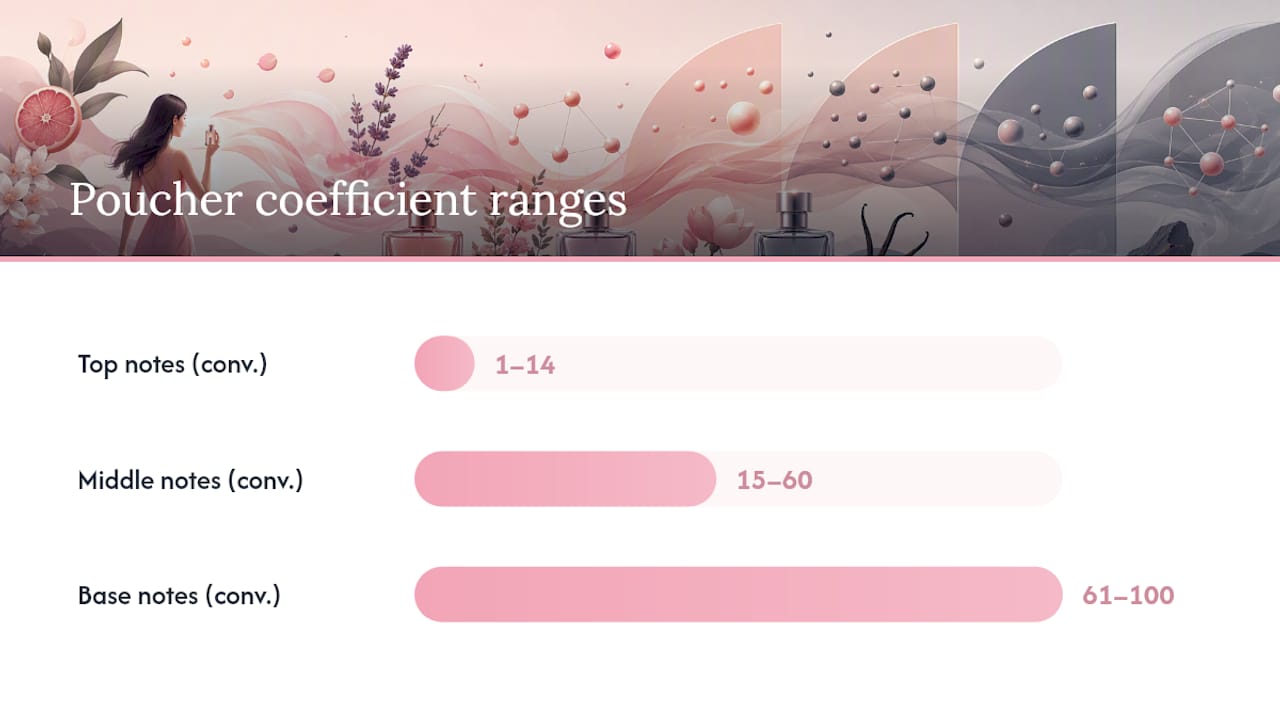
Top notes are made from small, light molecules with high vapour pressure, which means they turn from liquid to gas almost instantly on warm skin. Poucher’s evaporation coefficients place these materials at the most volatile end of the scale, roughly 1 to 14 on his grouping system, which is exactly why perfumers reach for them to open a fragrance. They hit your nose first because they are the most volatile components, evaporating first.
The families used here tend to share one trait: brightness that fades fast.
- Citrus oils such as bergamot, lemon, and mandarin, prized for a sharp, zesty opening
- Light herbs including basil, lavender, and mint, which add a green, aromatic lift
- Airy fruity accords like pear, raspberry, or apple, common in playful, youthful compositions
- Aldehydes and light aquatic notes, used for a clean, sparkling effect
Most top notes hold on for 15 to 30 minutes before fading into the heart of the fragrance. That window matters more than shoppers realise. A perfume that smells incredible on a card in a shop is really only showing you its opening act.
What are base notes and how do they behave?
Base notes are built from heavier, less volatile molecules that resist evaporating, which is why they linger on skin and clothing long after the initial spray has faded. According to Wikipedia’s overview of fragrance notes), these compounds often only become noticeable after around 30 minutes, once the lighter materials above them have thinned out, and they can persist for hours afterwards.
The materials that dominate this layer are dense and grounding, which is exactly what gives a scent its backbone:
- Woods such as sandalwood, cedarwood, and vetiver, offering warmth and structure
- Resins including amber, benzoin, and myrrh, which add richness and depth
- Musks, both natural-derived and synthetic, prized for their skin-like, lingering quality
- Gourmand notes like vanilla, tonka bean, and praline, adding sweetness that lasts
Base notes rarely announce themselves loudly. They build quietly underneath the top and heart, then take over completely during the dry-down, the final phase where a perfume settles into what it will smell like for the rest of the day. This is also where base materials do double duty as fixatives, slowing the evaporation of the more volatile ingredients above them and stretching the entire fragrance’s life on skin.
Why do top and base notes behave so differently?
The three-tier pyramid you see on every perfume counter is a teaching tool, not a strict chemical rule. In reality, every ingredient in a bottle starts evaporating from the first second it touches skin. What changes is which molecules are still around in strong enough concentration to register with your nose.
Two forces drive this. The first is vapour pressure, essentially how eager a molecule is to escape into the air. Citrus oils have high vapour pressure and burn off fast; sandalwood has low vapour pressure and clings on. The second is odour detection threshold, the minimum concentration at which a human nose can actually perceive a smell. Some base materials, particularly certain musks, have such a low detection threshold that a tiny lingering trace is still perceptible long after most of the top notes have physically disappeared.
Poucher’s coefficient system grades this on a scale, with top notes sitting around 1 to 14, middle notes around 15 to 60, and base notes stretching from 61 to 100. Those numbers are conventions, useful shorthand rather than laws of physics, and different perfume houses draw the lines slightly differently.
What you experience as one note “taking over” from another is really masking. The strongest, most volatile smell in the mix dominates your perception while it is present in high enough concentration, then fades and lets the next layer become audible, so to speak, as the noise around it dies down.
What do real fragrance pyramids actually look like?
Reading a pyramid on a product page gets much easier once you have seen a few laid outside by side.
- Citrus fresh: bergamot and grapefruit open things up, cedarwood and jasmine carry the middle, and musk with a touch of amber closes it out. Expect a lively first twenty minutes, a floral-woody middle stretch, and a soft, clean base by the evening.
- Gourmand vanilla: mandarin and pink pepper start it off, praline and rose sit in the heart, and vanilla with tonka bean anchors the finish. This one tends to smell sweeter and warmer the longer it wears.
- Woody amber: bergamot and pink pepper again for the opening, followed by a spicy heart of cinnamon and iris, before sandalwood and amber take over for hours.
Notice “amber” showing up twice. It is not a single raw ingredient at all but an accord, a constructed blend of resins and warm materials designed to read as one unified smell. Many note names describe an impression rather than an exact formula, so treat a pyramid as a sensory map, not an ingredients list.
Concentration changes the picture too. An eau de toilette (EDT) usually carries a lower percentage of fragrance oil than an eau de parfum (EDP), so the same pyramid will run its course faster in EDT form and last noticeably longer in EDP.
How should you test and layer scents in practice?
Blotters and skin tell you two different stories, and confusing them is the single most common mistake buyers make.
- Use a paper blotter for a quick first pass; it shows you the opening act and lets you compare several scents in one shop trip without overwhelming your nose.
- Always finish your decision on skin. Body heat changes vapour pressure and shifts which molecules you notice, so a scent that seemed flat on paper can bloom on your wrist.
- Wait at least 30 minutes before judging the heart notes, and give it several hours if you want to know what the base actually does.
- Spray, then walk away and get on with your day. Checking back in an hour tells you more than staring at your wrist for five minutes straight.
Pro Tip: If you want to layer scents rather than wear one alone, spray your heaviest, base-driven fragrance first as an anchor, then add a lighter citrus or fruity body mist on top, an hour or two later. The base holds the composition together while the mist keeps refreshing the top layer through the day.
Layering rewards patience and a bit of trial and error. Pairing a vanilla-forward base with a sharp citrus top tends to work because the two occupy different parts of the volatility scale and rarely fight each other for attention.
How body mist and perfume brands design scents for layering
Some brands build their body mists and perfumes around the idea of affordable, playful scents designed to be mixed rather than worn in isolation. That positioning only makes sense once you understand how top and base notes actually interact.
A gourmand, vanilla-heavy body mist works well as your base layer, holding warmth and sweetness on skin for hours. Add a citrus or fruity mist on top for daytime wear, and you get a fresh opening that fades into the richer scent underneath, changing how the fragrance reads from morning to evening without buying a whole new bottle.
What role do middle notes play between top and base?
Middle notes, often called heart notes, bridge the gap between the fleeting opening and the long-lasting base. They typically become noticeable once the top notes fade, usually somewhere in the one to four hour range, and they are the layer most perfumers treat as the true character of the fragrance.
Florals dominate this tier: rose, jasmine, ylang ylang, and geranium appear constantly, alongside spices like cinnamon, cardamom, and pepper, and softer fruit notes such as peach or plum that read less sharp than their top-note cousins. These materials sit at a middling point on the volatility scale, not fast enough to vanish in minutes, not heavy enough to anchor the whole scent alone.
The heart’s job is transitional but crucial. It smooths the handover from the top note’s sharp opening to the base note’s slow, heavy finish, and without it a perfume can feel disjointed, jumping from citrus straight to musk with nothing to soften the change. A well-built heart also interacts chemically with both layers, sometimes slowing the top notes’ evaporation slightly and helping the base notes emerge more gradually rather than all at once.
Think of the heart as the part of the fragrance that decides whether the overall composition feels balanced or lopsided. A perfume with a weak or clashing middle often smells brilliant for the first ten minutes and then confusing for the next hour, which is exactly why testing patience matters so much when you are deciding whether to buy.
Where did the idea of fragrance notes come from?
The musical metaphor behind “notes” traces back to nineteenth-century perfumer Georges Fouquet, who compared blending scents to composing music, with individual ingredients acting like notes that combine into chords and, eventually, an accord. The term stuck because it captured something true: a good perfume, like a good piece of music, relies on timing and structure, not just a pleasant sound or smell in isolation.
The formal top, middle, and base classification came later, largely systematised through work on evaporation rates and volatility groupings, including Poucher’s coefficient scale, which gave the industry a shared numerical language for describing how fast a material leaves the skin. Before that kind of standardisation, perfumers relied heavily on experience and instinct passed down through apprenticeship rather than measurable data.
What is often missed is that the pyramid was always meant as a communication tool aimed at customers and marketers, not a strict scientific model. It made a genuinely complex chemical process, dozens of molecules evaporating at different rates simultaneously, digestible in a single diagram. That simplicity is also its limitation: real formulas rarely separate as neatly into three clean bands as the pretty triangle on a perfume box suggests, which is worth remembering the next time a listing promises an exact, tidy structure.
How do fixatives and solvents change how long a scent lasts?
Fixatives are ingredients added specifically to slow down evaporation, and they are a major reason two perfumes with similar top notes can wear completely differently. Heavy base materials such as resins, musks, and certain woods do this naturally, physically binding to lighter molecules and holding them closer to the skin for longer.
Solvents matter just as much, even though shoppers rarely think about them. Most fragrances are diluted in ethanol or a similar carrier, and the ratio of fragrance oil to solvent, not just the notes themselves, determines longevity. This is the real difference between an EDT, an EDP, and a parfum: the concentration of oil is higher as you move up that scale, which means more fixative material is present relative to the volatile top layer, and the whole scent simply lasts longer on skin.
Skin type plays into this too. Drier skin holds fragrance oils less effectively than oilier skin, so the same bottle can feel shorter-lived on one person and impressively long-lasting on another. Temperature and humidity shift evaporation rates as well, which is why a scent that felt subtle in a cold shop can bloom noticeably once you are outside on a warm day.
None of this is really about one ingredient overpowering another. It is about the overall chemical mixture, oils, fixatives, and solvent together, slowing the loss of volatile material enough that the fragrance still has something left to show hours after application.
Do natural and synthetic ingredients smell and last differently?
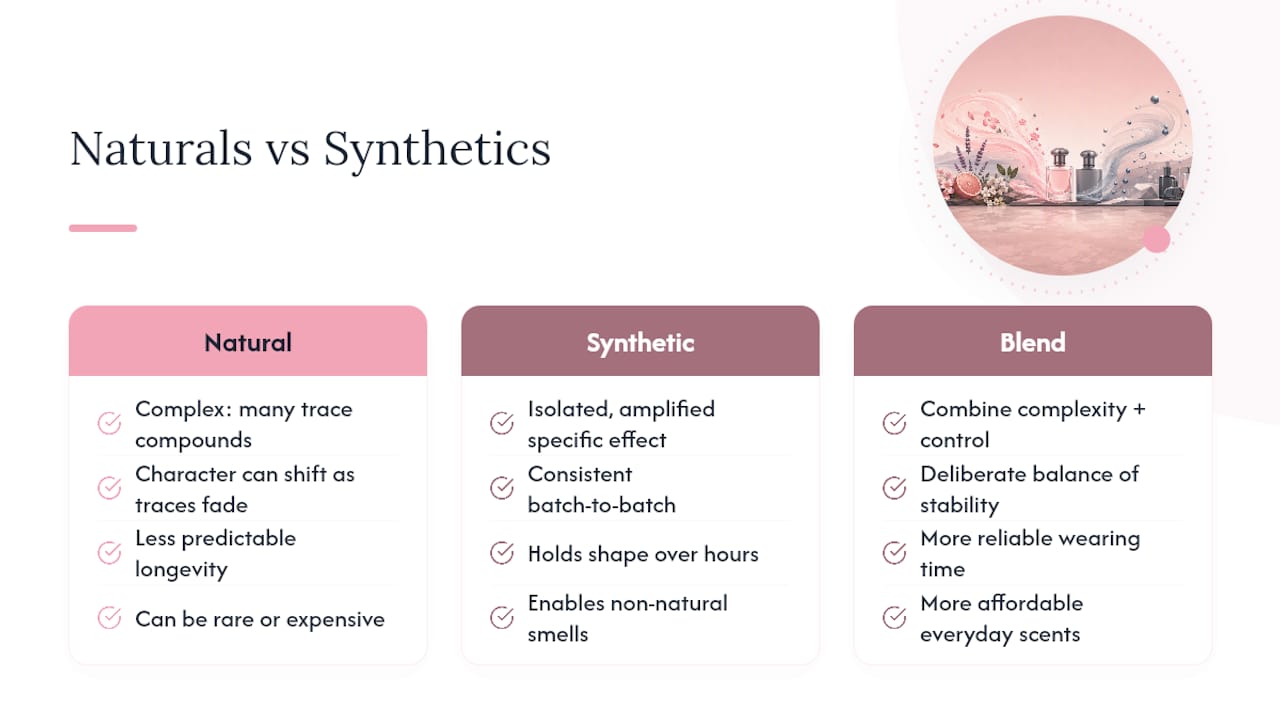
Natural extracts, essential oils, absolutes, tend to carry a complex, slightly unpredictable character because they contain dozens or even hundreds of trace compounds alongside the dominant one. A natural bergamot oil, for instance, brings its signature citrus sharpness plus a faint bitterness and depth that comes from everything else naturally present in the peel.
Synthetic materials, by contrast, are built to isolate and amplify a specific effect with far more consistency batch to batch. This is not a downgrade. Many of perfumery’s most iconic base notes, certain musks especially, exist almost entirely as synthetic molecules because the natural equivalents are rare, expensive, or in some cases no longer permitted for use. Synthetics also gave perfumers access to smells that do not exist in nature at all, expanding what a fragrance can even attempt to evoke.
Where the two genuinely differ is longevity and stability. Naturals often evaporate less predictably and can shift in character as different trace compounds fade at different speeds. Synthetics are engineered for a more consistent decline, which is one reason modern base notes lean so heavily on synthetic musks and fixatives: they hold their shape reliably over hours rather than drifting.
Neither approach is inherently superior. A fragrance built entirely from naturals can smell gorgeous but wear unpredictably; one built entirely from synthetics can last impressively but feel flat. The best compositions, and most affordable everyday fragrances, blend both deliberately, using naturals for character and synthetics for consistency and staying power.
Editor’s perspective: choosing scents for everyday layering
If there is one habit worth building, it is prioritising the base before anything else. A fragrance’s foundation decides whether you will still like it in six hours, and that matters far more than how exciting the first spritz feels in a shop.
Body mists are underrated for this exact reason. They are cheap enough to experiment freely, so you can build a small rotation of anchors and top layers without worrying about wasting money on a full bottle that turns out wrong on your skin.
My honest advice: never buy sight unseen. Sample, wait, walk around, then decide.
— Damini
How layering products can offer affordable scent mixing options
Layering only works if you can actually afford to experiment. Building your own combination from a range of affordable body mists and perfumes designed specifically for mixing enables that.
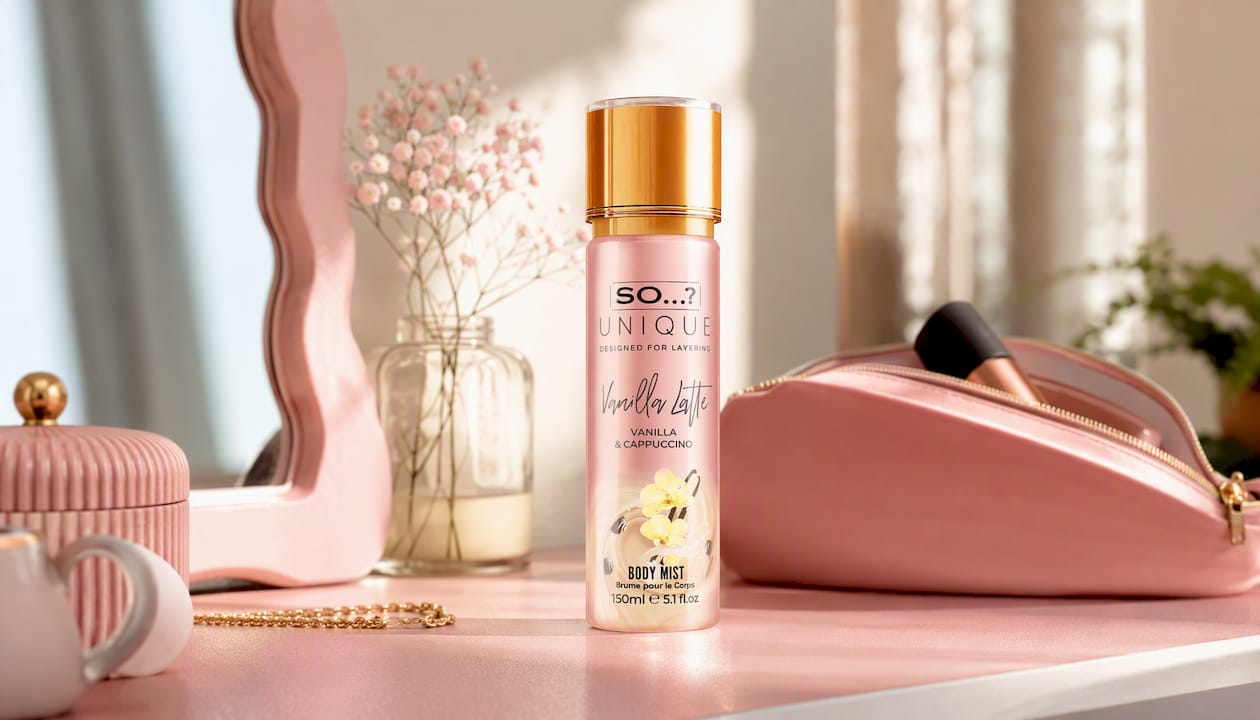
The SO…? Unique Vanilla Latte Body Mist is a good example of a base-heavy layer, warm and gourmand, that works as your anchor scent for the day. Pair it with a lighter, citrus-driven mist from the SO…? Unique collection for a fresher daytime version, or reach for something from the full perfume range when you want a longer-lasting single scent instead. Everything sits at an accessible price point, so testing a new combination costs a fraction of a designer bottle.
Start by browsing the full Sofragrance catalogue and picking one anchor and one top layer to try together this week.
Further reading and primary sources
- Perfume materials and volatility, NCBI Bookshelf, on Poucher’s evaporation coefficients
- Fragrance notes explained, Molton Brown, on testing and typical note families
- Scent notes and the fragrance pyramid, Premiere Peau, on the pyramid as a convention
Sources
- Perfume materials and volatility (NCBI Bookshelf)
- Scent notes & the fragrance pyramid explained | Premiere Peau
FAQ
Should I layer perfume with base notes or top notes first?
Apply your base-heavy fragrance first as an anchor, then add a lighter top-note scent afterwards. This lets the heavier base hold the combination together while the lighter layer refreshes throughout the day.
What is the difference between top, heart, and base notes?
Top notes are the volatile ingredients you smell in the first 15 to 30 minutes, heart notes form the transitional middle character over the next few hours, and base notes are the heavy, slow-evaporating materials that give a perfume its lasting foundation. Each tier reflects how quickly its ingredients evaporate, not a strict switch from one to the next.
What does top note, middle note, and base note actually mean?
They describe a fragrance’s evaporation timeline: top notes appear immediately and fade fastest, middle notes emerge as the top fades and carry the perfume’s main character, and base notes linger longest, often for hours after application. The pyramid is a convention for describing a continuous chemical process, not three separate stages that switch on and off.
Which notes do you smell the most in a perfume?
Over a full day of wear, base notes and heart notes dominate your overall impression simply because they last the longest, even though top notes make the strongest first impression in the shop. This is exactly why testing on skin and waiting before buying matters more than judging a fragrance from a blotter alone.
Can Sofragrance body mists be layered with other scents?
Yes. Sofragrance designs its body mists specifically to be mixed, so a warmer, base-driven mist can anchor a lighter, citrus or fruity mist layered on top. Current prices and full ranges are available on the Sofragrance website.
