

-

Passionfruit Body Mists: How to Wear, Layer and Choose Oct 25, 2026
-

Sweet vs Fresh Perfumes: How to Choose Your Scent Oct 24, 2026
-

Frangipani Body Mists: How to Choose, Wear and Layer Oct 23, 2026
-

Gourmand vs Floral Perfume: How to Choose and Layer Oct 22, 2026
-

Perfume on a Plane in the UK: What You Can Pack in 2026 Oct 21, 2026
-

Almond Body Mists: Scents, Layering Ideas and How to Choose Oct 20, 2026
-

Green Tea Body Mists: How to Choose and Layer One Oct 19, 2026
-

Gardenia Body Mists: Find Your Tone With a Mini Discovery Set Oct 18, 2026
-

Floral vs Fruity Perfume: Layer Them Without Clashing Oct 17, 2026
-

Perfume Projection vs Longevity: Test First, Layer Second Oct 16, 2026


Deodorant controls odour; body mist provides fragrance. They solve different problems, which is why the smartest routine uses both rather than picking one over the other. Body mists work best layered on top of a proper deodorant, not instead of it.
TL;DR:
- Body mists are designed for scent only and typically last only 2 to 4 hours, making them unsuitable as a sole solution for odour control.
- Deodorants and antiperspirants are formulated to interrupt bacterial odour and manage sweat, with application best after showering on clean, dry skin.
- Layering deodorant underneath and mist on pulse points or clothing ensures functional odour control combined with personal fragrance.
- Alcohol-based formulas can cause irritation on sensitive or shaved skin, so patch-testing and waiting after shaving is advised before use.
- For active days or workouts, deodorant is essential, while body mist alone suffices for short outings or casual refreshes.
Table of Contents
- Body mist vs deodorant: a quick side-by-side comparison
- What deodorants and antiperspirants actually do
- What body mists and sprays are designed for
- Scent strength, longevity and skin: where the real differences show
- How to layer deodorant and body mist properly
- Skin and safety considerations worth knowing
- Which one should you reach for? Gym, office, date, and quick refresh
- Layering as personal expression
- Where SO…? body mists fit your routine
- Sources
- FAQ
Body mist vs deodorant: a quick side-by-side comparison
Before you reach for either bottle, it helps to know what each one is actually built to do. Deodorant and antiperspirant exist to manage sweat and bacteria; body mist exists to make you smell good. Some products blur that line on purpose, so it’s worth checking the label before assuming a “body spray” controls odour the way a deodorant does.
- Deodorant/antiperspirant: primary function is odour and sweat control, lasts several hours depending on product, applied to clean underarms.
- Body mist: primary function is fragrance, lasts a few hours on skin, applied to pulse points, hair, and clothing.
- Whole-body deodorant sprays: a smaller category formulated for wider skin coverage, often alcohol-free to reduce sting.
- Hybrid “body sprays”: some contain deodorant actives despite being marketed like a mist, so checking the label matters more than the product name does.
Grooming guides consistently frame these as complementary products rather than substitutes, and the comparison below explains exactly why.
What deodorants and antiperspirants actually do
Deodorants work on bacteria, not sweat. Sweat itself carries no smell; odour appears once bacteria on your skin break it down, which is why deodorants are formulated to interrupt that bacterial process rather than to dry you out. Antiperspirants take a different route, using aluminium compounds to temporarily reduce how much you sweat in the first place. Many everyday products combine both actions in one roll-on or spray, often marketed with claims like 24-hour protection.
Application matters more than people assume. Deodorant and antiperspirant work best on clean, dry underarm skin, applied at night or straight after a shower once skin has fully dried. Freshly shaved underarms are more sensitive; a strong formula can sting on contact. Waiting some time after shaving before applying gives the skin time to settle and can reduce irritation.
What body mists and sprays are designed for
Body mist is essentially a lighter, more diluted cousin of perfume. It carries a higher water and alcohol ratio and a lower concentration of fragrance oil, which is exactly why it fades faster and feels softer on skin than an eau de parfum. Expect roughly 2 to 4 hours of noticeable scent from skin application, less if you’re active or it’s a warm day.
The natural application zones are pulse points, wrists, collarbone, hair, and clothing rather than underarms specifically. Spraying onto clothes can actually extend how long a scent lasts, since fabric holds fragrance differently to skin. One thing worth knowing: marketing language often calls a product “body spray” or “deodorant spray” almost interchangeably, even when the formulas do very different jobs. That’s precisely why reading the label, not the name on the front, tells you what you’re actually buying.
Scent strength, longevity and skin: where the real differences show
The gap between these two products becomes obvious the moment you factor in activity, humidity, and skin sensitivity. Deodorant is engineered to hold up under heat and movement, that’s its entire purpose, while a body mist will fade noticeably faster on a hot day or during exercise because its fragrance concentration was never built for endurance. Scent projection works in the opposite direction too: a mist is designed to be noticed up close, not to fill a room, whereas some antiperspirants leave a faint background scent as a side effect rather than a feature.
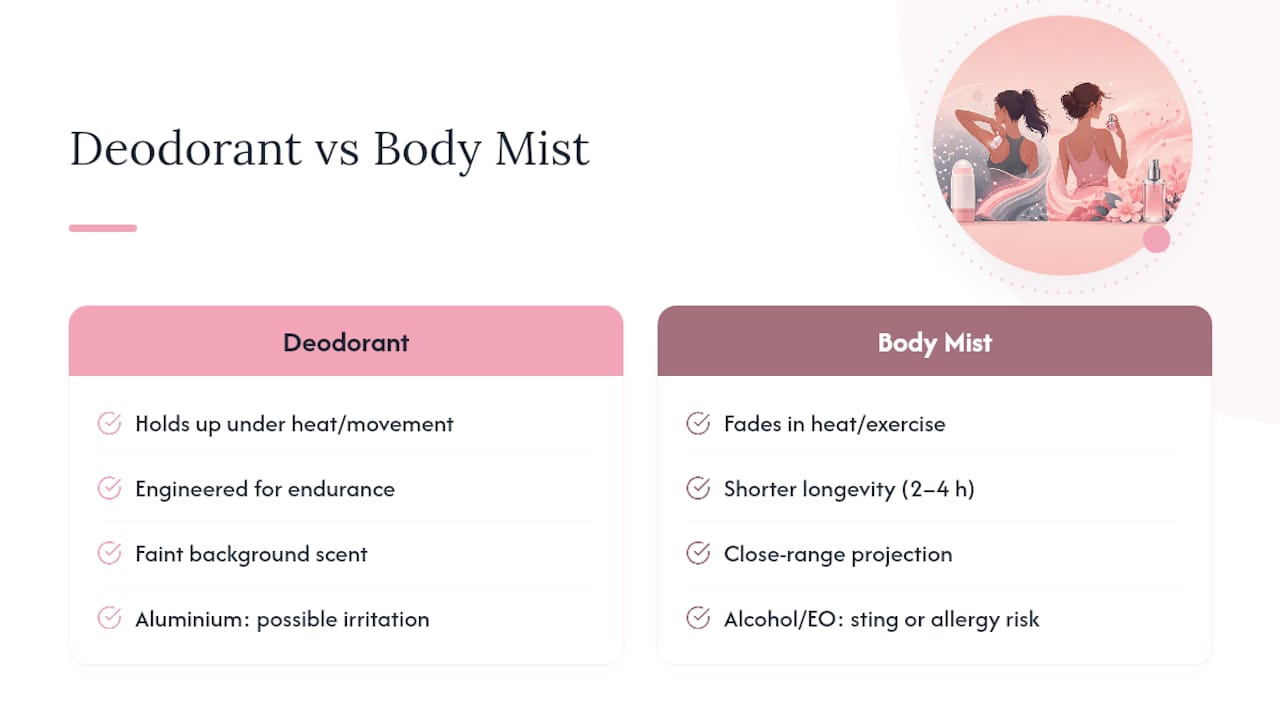
Ingredients tell their own story. Aluminium compounds in antiperspirants can irritate sensitive underarm skin for some people, while alcohol in sprays can sting broken or freshly shaved skin. Essential oil blends in mists sit somewhere in between, generally gentler but not risk-free for allergy-prone skin.
There’s also an unspoken etiquette here. In shared offices, gyms, or lifts, heavy mist application reads very differently to a light, well-placed spritz. Odour control should never be optional in those spaces; scent intensity is where you have room to dial it back.
How to layer deodorant and body mist properly
Getting the order right avoids two common mistakes: masking body odour with fragrance instead of controlling it, and wasting a good scent by spraying it straight onto damp deodorant.
- Apply antiperspirant or deodorant to clean, dry underarms first, ideally right after showering.
- Give it a few minutes to fully set and absorb before dressing.
- Spritz your body mist onto pulse points, hair, or clothing rather than directly over the deodorant itself.
- Reapply the mist through the day as needed since it fades faster than deodorant does.
Layering fragrance this way, functional protection underneath and personality on top, is the routine most grooming experts land on because it lets each product do the one job it’s actually good at.
Pro Tip: Pick one dominant note, vanilla, musk, or a fruity floral, and test the combination on a fabric swatch before committing. Mixing two strong scents directly on skin is how you end up with a clash instead of a signature.
Skin and safety considerations worth knowing
Alcohol is the main irritant to watch for in both categories. It can sting on broken, shaved, or already sensitive skin, so alcohol-free formulations exist specifically for people who want to apply fragrance more broadly than just the underarms.
If you’ve shaved recently, wait a few hours before applying anything with alcohol or fragrance oils to that area. For sensitive skin generally, patch-test a new product on your inner forearm and wait 24 hours before applying it to a larger area. Stop using anything that causes redness, itching, or a burning sensation, and don’t push through irritation hoping it settles on its own.
Which one should you reach for? Gym, office, date, and quick refresh
The honest answer depends on what you’re actually doing that day, not which bottle is prettier.
- Gym or active days: antiperspirant or deodorant does the heavy lifting; a mist alone won’t survive a workout.
- Quick errand or short outing: a spritz of body mist can genuinely be enough on its own.
- Office or all-day wear: deodorant as your base, then a light mist reapplied mid-afternoon if needed.
- Evening or date: layer both, deodorant for confidence, a distinctive mist like SO…? Musk for personality.
Buy the function you need first. Fragrance is the fun part, but it’s the part you get to choose freely once odour control is already sorted.
Layering as personal expression
Fragrance shouldn’t be an afterthought squeezed in after deodorant. Damini, writing on behalf of Sofragrance’s grooming team, sees layering as the point where function ends and personality starts, and it’s why SO…? mists are built to be mixed, worn differently each day, and treated as an accessory rather than a chore.
— Damini
Where SO…? body mists fit your routine
Once your deodorant is handling the actual job of odour control, the scent part becomes entirely yours to play with, and body mists can offer the versatility to be mixed, swapped, and layered without a second thought.
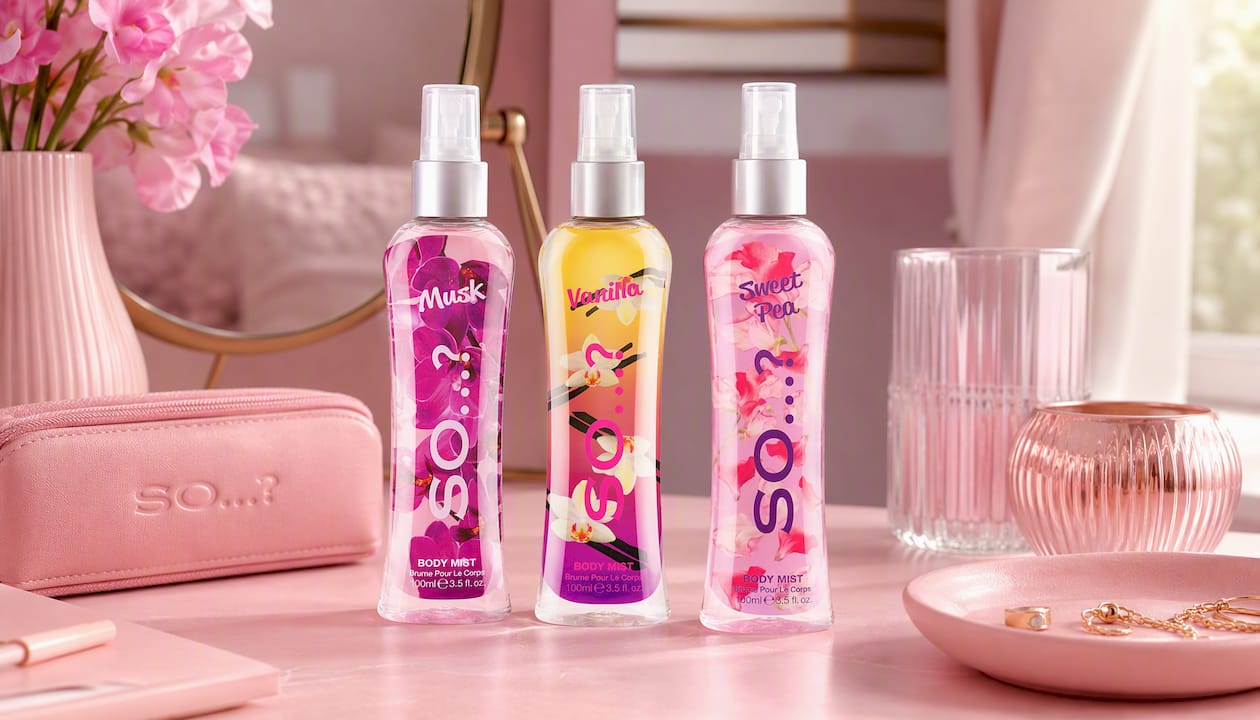
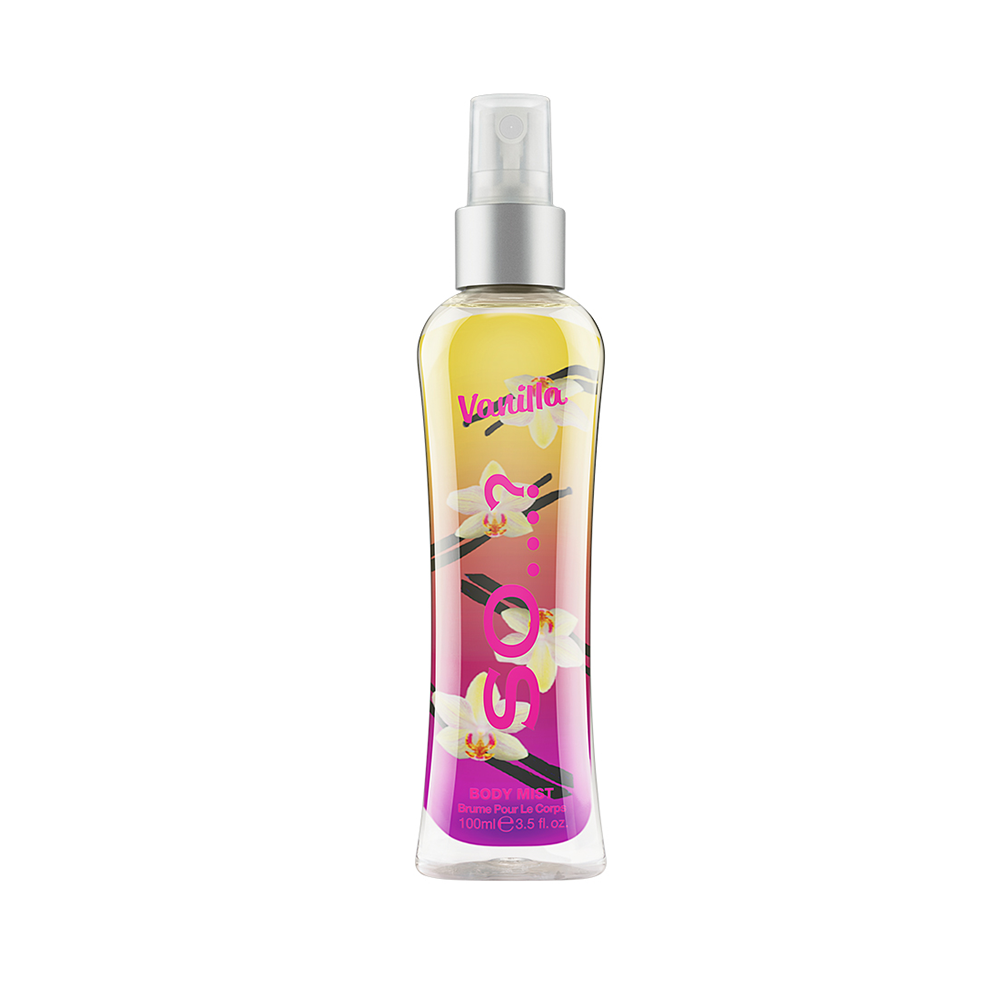
SO…? Musk Body Mist 100ml works as a warm, slightly grown-up base note for evenings out. SO…? Vanilla Body Mist 100ml is the everyday comfort scent, soft enough for the office and easy to reapply through the day. SO…? Sweet Pea Body Mist 100ml brings a youthful floral lift that layers well under either of the other two. All three also make an easy gift bundle if you’re buying for someone who likes choosing their own combinations. Browse the full body mist collection and pick the pairing that fits your week.
Sources
- Deodorant vs Body Mist: What Is The Difference And Which One Should You Use? - NDTV Shopping
- Sweat gland — Wikipedia
- Coconut Vanilla Whole Body Deodorant Spray – Dove
FAQ
Can body mist be used as deodorant?
No. Body mist adds fragrance but doesn’t interrupt the bacterial process that causes odour, so it won’t stop underarm smell the way a proper deodorant does.
What is better, body spray or deodorant?
Neither is “better” since they do different jobs; deodorant controls odour and sweat, while body spray adds scent, and most people get the best result using both.
What is a body mist used for?
Body mist is a lighter, water-based fragrance meant for pulse points, hair, and clothing, giving a softer, shorter-lasting scent than perfume or eau de parfum.
Can body mist be used on armpits?
You can spray a mist on underarms, but it won’t control odour or sweat, so it’s not a substitute for deodorant in that specific spot, though whole-body deodorant sprays are formulated for wider safe use.
