

-

Passionfruit Body Mists: How to Wear, Layer and Choose Oct 25, 2026
-

Sweet vs Fresh Perfumes: How to Choose Your Scent Oct 24, 2026
-

Frangipani Body Mists: How to Choose, Wear and Layer Oct 23, 2026
-

Gourmand vs Floral Perfume: How to Choose and Layer Oct 22, 2026
-

Perfume on a Plane in the UK: What You Can Pack in 2026 Oct 21, 2026
-

Almond Body Mists: Scents, Layering Ideas and How to Choose Oct 20, 2026
-

Green Tea Body Mists: How to Choose and Layer One Oct 19, 2026
-

Gardenia Body Mists: Find Your Tone With a Mini Discovery Set Oct 18, 2026
-

Floral vs Fruity Perfume: Layer Them Without Clashing Oct 17, 2026
-

Perfume Projection vs Longevity: Test First, Layer Second Oct 16, 2026


Perfume develops differently on every person because skin moisture, oil levels, pH, resident microbes, genetics, and body temperature all interact with fragrance molecules in slightly different ways. These factors change how quickly notes evaporate, how they transform, and how you perceive them. The single most useful thing to do before buying anything is skip the counter tester and spray it on your own skin. Then check back over several hours.
TL;DR:
- Skin hydration and oil levels significantly affect fragrance retention and evaporation speed, making moisturized and oily skin hold scents longer.
- Fragrance tests on counter strips differ from real wear because oxidation and environmental factors like heat and humidity alter scent perception over time.
- Testing perfume on your own skin at multiple intervals, with clean, unscented skin and logged observations, provides the most accurate understanding of how it will wear on you.
- Scent characteristics vary with body temperature, skin pH, and microbiome, which explains why the same fragrance can smell different on different people.
- Using affordable, layered formats like body mists and smaller bottles encourages better testing and selection based on your unique skin chemistry.
Table of Contents
- What actually happens between perfume and skin chemistry?
- Why does the tester smell different from the bottle I bought?
- How do you test a perfume properly on your own skin?
- How do you choose a perfume that suits your skin type?
- Does the skin’s pH actually change how perfume smells?
- A personal note on scent, chemistry, and change
- Finding your fit through affordable layering
- Sources
- FAQ
What actually happens between perfume and skin chemistry?
The phrase “skin chemistry” gets thrown around a lot in fragrance marketing, and it’s worth being precise about what it actually means. It’s not that your skin transforms rose into leather. It’s that a handful of measurable biological variables nudge how quickly a fragrance evaporates, which notes come through strongest, and how long the whole thing lasts. Understanding fragrance and skin interaction at this level makes shopping for scent far less of a gamble.
Hydration and oil are the biggest levers you control. Well-hydrated skin holds onto fragrance molecules longer than dry skin, because moisture slows the rate at which volatile compounds evaporate off the surface. Research linking skin hydration to fragrance retention found that better-hydrated skin correlates directly with slower evaporation, which is why perfumers have always told people to moisturise before spraying. Oily skin behaves similarly in one sense (it traps molecules) but can also warm up faster, which pushes volatile top notes off skin sooner while holding onto heavier base notes longer.
Skin pH plays a smaller but real role. The skin’s natural acid mantle typically sits slightly acidic, and that environment can subtly affect how stable certain aromatic molecules are once they land on you. It doesn’t rewrite a fragrance family, but it can shift how quickly certain top notes fade relative to the base.
The skin’s resident microbes matter too, though probably less than people assume. One analysis of how skin changes perfume found that clean, dry skin causes limited chemical transformation overall, but certain sites, underarms especially, show microbially catalysed changes because that’s where bacterial activity is highest. This is part of why the same fragrance can smell slightly different on your wrist than under your arm.
Genetics is the wildcard nobody controls. Humans carry roughly 400 different olfactory receptor genes, and individual variation in those genes means two people can smell the exact same molecule and perceive it differently, according to Duke University’s coverage of olfactory receptor research. Add genes linked to the immune system’s MHC complex, which also shape body odour and preference, and you get a biological explanation for why a scent that’s magnetic on your friend can smell flat on you.
Body temperature and pulse points round out the picture:
- Warmer skin at the wrists, neck, and behind the ears speeds up evaporation, which is why those spots project fragrance faster.
- Higher body temperature generally means shorter top-note life but sometimes stronger initial projection.
- Cooler skin areas hold fragrance closer to the surface for longer, delaying the drydown.
None of these factors work in isolation. They stack, which is exactly why a fragrance that’s stunning on a shop assistant can behave completely differently once it’s on you.
Why does the tester smell different from the bottle I bought?
Because it usually is different, chemically. Testers sitting on a counter get sprayed dozens of times a day and sit exposed to air, light, and handling, which oxidises the fragrance oils faster than a sealed bottle at home. That oxidation can flatten sharper top notes or brighten others, so what you smell in the shop is rarely an exact match for the bottle in your bag three weeks later.
Environment does the rest of the damage to consistency. A boutique with controlled air conditioning and low humidity is nothing like a warm commute, a summer garden party, or a fabric-heavy winter coat. Heat and humidity both accelerate evaporation and widen projection, which is why perfumes tend to feel “bigger” in July than in January regardless of the formula itself.
There’s also a less obvious layer to this: fragrances don’t just interact with your skin, they interact with the air around you. Research into personal care products and indoor air chemistry found that fragranced products and lotions measurably alter near-skin and indoor chemical processes. In one experiment, applying body lotion reduced a specific skin-derived oxidation compound (6-MHO) by a measurable amount. That’s not a health verdict on wearing perfume. It’s evidence that what you put on your skin changes the chemistry happening just above it, which is a fair way to explain why a room full of people wearing fragrance smells different from an empty one.
A few practical consequences follow from all this:
- Never judge a fragrance purely from a paper strip or counter tester; both skip the skin-interaction stage entirely.
- Spray on clean, product-free skin, not skin layered with someone else’s lotion or an old spritz of something else.
- Re-check the scent at least three hours later in normal conditions, not standing under shop lighting.
- Treat a boutique’s climate-controlled air as a poor stand-in for how the scent will behave outdoors or in a warm room.
If a fragrance smells sharp or synthetic on the tester strip but softens beautifully on your wrist an hour later, that’s the skin interaction doing exactly what it’s meant to do.
How do you test a perfume properly on your own skin?
Testing on skin, deliberately and patiently, is the only reliable way to know how a fragrance will actually behave on you. Shop testers and paper strips skip the whole point.
- Start with clean, unscented skin. Wash the test area and let it dry fully. Any leftover lotion, deodorant, or old fragrance will contaminate the result.
- Apply a single spray to one spot. Wrists, the inner elbow, or behind the ear all work; the inner elbow is gentler for sensitive skin since it gets less friction and washing than wrists.
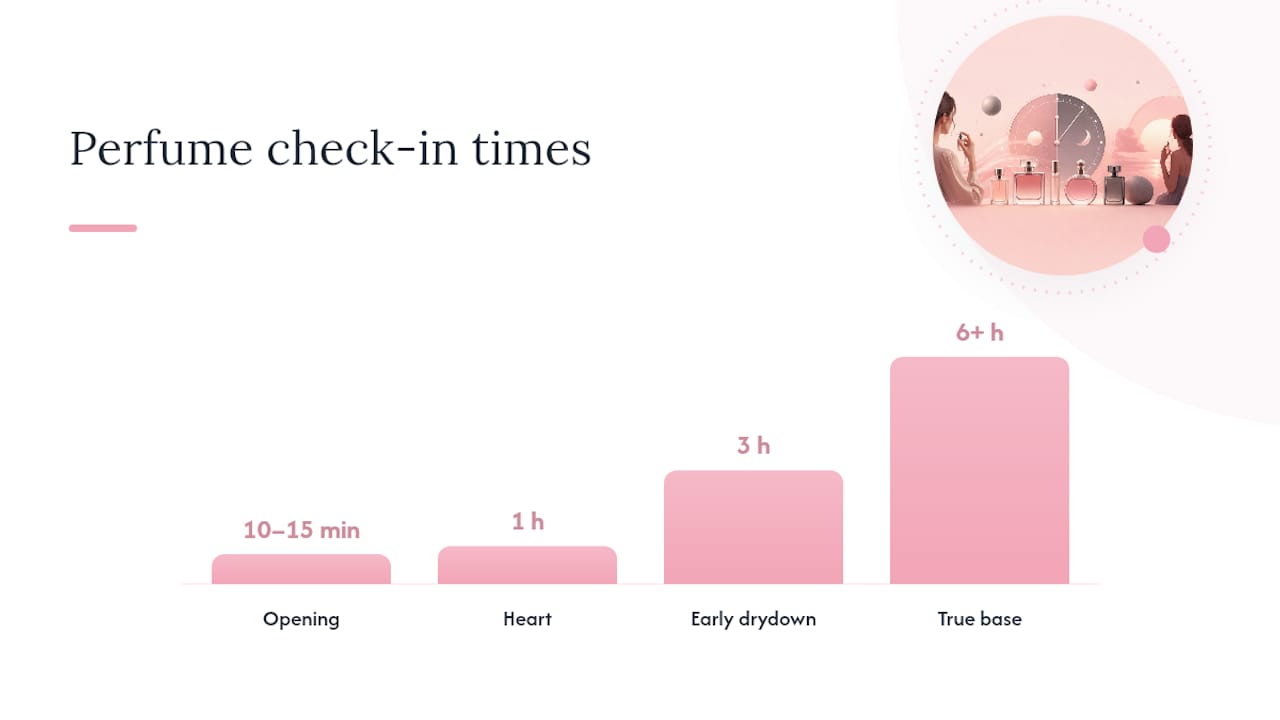
- Check in at four intervals. Smell it at 10 to 15 minutes (the opening), at one hour (the heart), at three hours (the early drydown), and again at six-plus hours (the true base). Most people only ever smell the opening, which tells you almost nothing about how a perfume actually wears.
- Change one variable at a time. If you want to know whether moisturising helps longevity, test the same fragrance on moisturised skin one day and bare skin another. Testing two variables at once (say, a new lotion and a new fragrance) muddies the result.
- Log what you notice. A simple three-line note works: what you smelled at each check-in, how strong the projection was, and whether you liked it enough to wear again.
Patch testing matters for comfort as much as scent accuracy. The inner elbow or behind the ear are gentler test sites than wrists, which get washed constantly and exposed to friction and sun. If you have sensitive skin, patch test a new fragrance there first and wait 24 hours before applying it more broadly, watching for redness, itching, or a burning sensation.
Watch for red flags during testing: immediate irritation is an obvious stop signal, but so is a fragrance that shifts sharply and unpleasantly within the first hour, or one that dries down to something consistently unappealing across two or three separate test days. A fragrance that’s slightly “off” on day one but lovely by day three isn’t a fluke. Your skin’s baseline changes daily with hydration, diet, and even stress, so one bad test isn’t a verdict.
Pro Tip: Test new fragrances on a day you haven’t changed your soap, laundry detergent, or skincare routine. Those background scents blend with the fragrance and can throw off your read on how it actually performs on bare skin.
How do you choose a perfume that suits your skin type?
Once you know how your skin behaves, shopping gets a lot more targeted. A few reliable patterns show up again and again.
If your skin runs oily or naturally warm, you’ll usually get more mileage out of base notes like woods, musks, and ambers, because oil traps and slow-releases heavier molecules well. Lighter citrus and green notes tend to burn off fast on oily skin, so a scent that felt fresh at 9 a.m. might vanish by lunch.
If your skin runs dry, moisturise with an unscented lotion before spraying. Dry skin has less to hold fragrance molecules against, so scent evaporates faster and can smell thinner overall. This is where hydration research earns its keep: better-hydrated skin retains fragrance measurably longer than dry skin.
Concentration matters as much as skin type. Eau de parfum and true parfum concentrations carry more fragrance oil relative to alcohol, so they last longer and suit anyone wanting a scent to survive a full day. Body mists and eau de toilette formulas are lighter and fade faster by design, which makes them ideal for layering, refreshing through the day, or testing a new note without committing to something heavy.
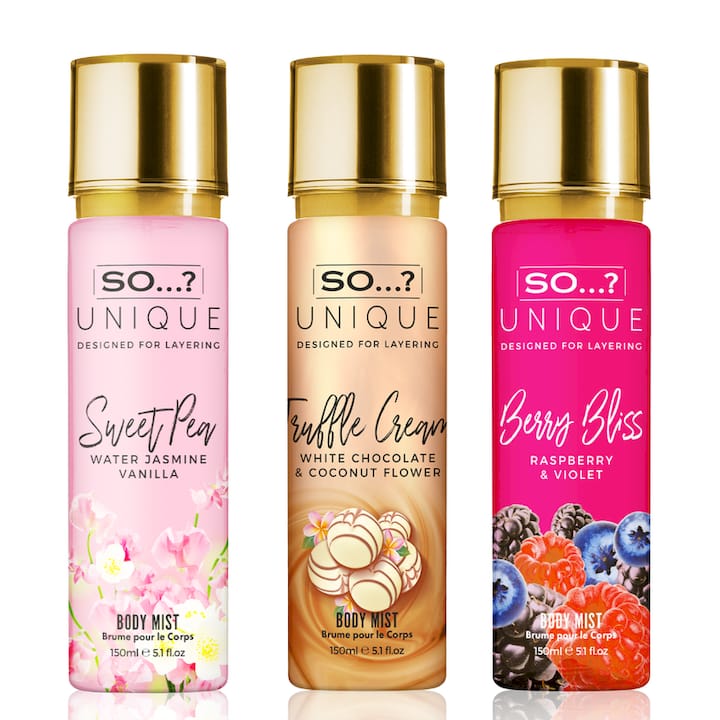
Layering is where affordable formats genuinely shine. A simple routine: unscented moisturiser first, then a light body mist, then, if you want more staying power, a small spritz of an EDP over the top. This lets you build a scent in stages rather than betting everything on one bottle, and it’s a big part of why small, inexpensive layering mists exist as a category. Buying three or four affordable options to experiment with costs far less than one designer bottle that turns out wrong on your skin.
Some fragrance families are just more forgiving across different skin types than others:
- Woody and oriental blends tend to behave consistently because their heavier molecules aren’t as sensitive to evaporation speed.
- Citrus and green notes are the most volatile and skin-dependent, often the first thing to disappear on warm or oily skin.
- Gourmand and sweet florals sit in the middle, usually stable but capable of turning noticeably sweeter on warmer skin.
Season matters too. Heavier scents that feel perfect in winter under a coat can feel overpowering in summer heat, when warm skin projects fragrance further and faster. Lighter mists earn their place here, letting you scale intensity up or down without switching your whole collection.
Does the skin’s pH actually change how perfume smells?
Your skin’s surface normally sits on the acidic side, a protective layer often called the acid mantle. It’s not identical from person to person, and it can shift with age, skincare habits, and even the products you use daily. That variation plays a real, if modest, role in how fragrance behaves once applied.
Some aromatic compounds are more chemically stable in a slightly acidic environment than others, which means the exact pH your skin sits at can influence how quickly certain top notes break down relative to the rest of the composition. This doesn’t turn a citrus fragrance into a woody one. It’s closer to a volume dial than a genre change, nudging how fast certain notes fade rather than replacing them altogether.
Where this becomes practical is in explaining a common complaint: “This smelled amazing on my friend but weird on me.” Two people testing the same fragrance side by side, with genuinely different skin pH, hydration, and oil levels, can walk away with different experiences of the same bottle without either of them being wrong. It’s also why professional perfumers rarely trust a single tester strip. Skin is not glass or paper, and paper doesn’t have an acid mantle to react against.
Skincare products can shift this balance too. Harsh soaps, strong acids like glycolic or salicylic acid, and some acne treatments raise or lower surface pH temporarily, which is one more reason a fragrance can smell slightly different on the same skin week to week. If you’ve changed your skincare routine recently and a favourite scent suddenly reads differently, that’s a plausible reason why, not a faulty bottle.
A personal note on scent, chemistry, and change
Your relationship with fragrance isn’t fixed, and that’s worth saying plainly because so much fragrance advice implies you should find “your scent” and stop looking. Skin chemistry shifts with age, hormones, medication, diet, and even the seasons, so a fragrance you wore religiously five years ago might smell completely different on you today. That’s not a flaw in the formula. It’s your own biology moving on.
What I’d actually recommend is keeping a simple scent log, nothing elaborate, just a note of what you tried, when, and how it wore. Revisit favourites every so often rather than assuming they’ll always perform the same way. The subtle differences people worry about, “why does this smell different on me,” are almost always normal variation, not a sign something’s wrong with your skin or the bottle. That unpredictability is genuinely part of what makes fragrance interesting rather than a problem to solve once and forget.
— Damini
Finding your fit through affordable layering
Testing on skin is the whole point of this article, and the cheapest, lowest-risk way to do that testing is with small, affordable formats rather than committing to one expensive bottle. A fragrance brand built its range around exactly that kind of experimentation.
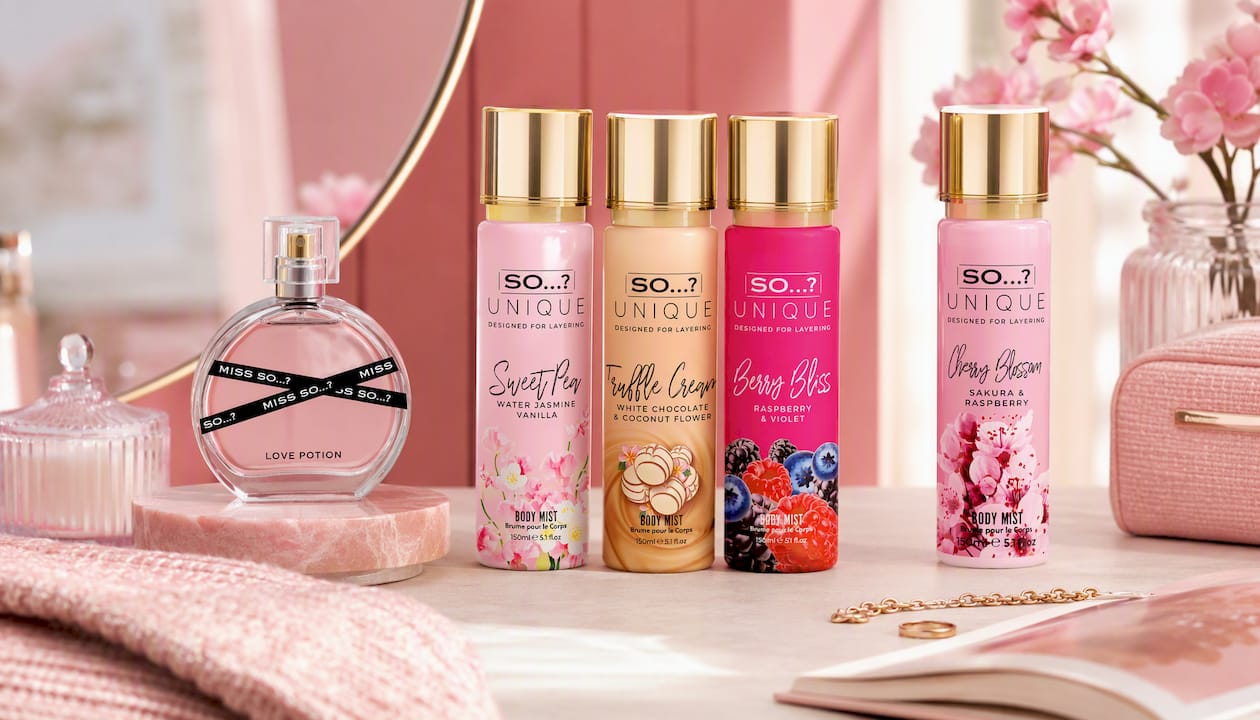
The Miss SO…? Love Potion Eau de Perfume works well for the longevity checks described earlier in this guide, since an EDP concentration gives you enough staying power to properly judge the three-hour and six-hour marks on your own skin. For layering experiments, the Berry Nice Fragrance Bundle gives you three body mists in one purchase, which is a practical way to compare how different notes behave on your specific skin without buying three full-price bottles. And the SO…? Unique Cherry Blossom Body Mist is light enough to layer over a base scent or wear alone on days you want something more subtle.
None of these claim to defeat your skin chemistry. They’re simply an inexpensive way to run the testing routine this guide walks through, so you find what actually works on you rather than what worked on someone else. Start by picking one bundle or mist and running the four-checkpoint test above.
Sources
- Study linking skin hydration to fragrance retention
- Duke University coverage of olfactory receptor genetic variation
- Study on personal care products and human oxidation field
FAQ
How do I know my skin chemistry for perfume?
You don’t need a lab test. Spray a fragrance on clean skin and observe it at 15 minutes, one hour, and three-plus hours; how quickly it fades and which notes dominate tells you whether your skin runs dry, oily, warm, or cool for fragrance purposes.
Does spraying perfume on skin disrupt hormones?
There’s no evidence that normal perfume use disrupts hormones. Fragrance ingredients and lotions do measurably alter near-skin and indoor air chemistry, but that’s a chemistry effect, not a hormonal one.
Is it healthy to put perfume on your skin?
For most people, wearing perfume on skin is fine, though those with sensitive skin or known allergies should patch test on the inner elbow first and watch for irritation over 24 hours.
Where should you not put perfume on your body?
Avoid spraying directly on broken, irritated, or freshly shaved skin, and be cautious near the eyes and mucous membranes. Pulse points like wrists and neck work well for most people, but anyone prone to sensitivity should patch test behind the ear first.
