
-

Box Most Bottles and Use a Daily Mist: 5 Perfume Storage Rules Sep 17, 2026
-

Layer, Don't Pick: Body Mist vs Perfume in the UK for 1–3 Hour Refresh Sep 16, 2026
-

Body Mist for Dry Skin: 2–3 Layers That Last for Young Women Sep 15, 2026
-

Try 12 Mini Scents: Fragrance Trends 2026 Without a Full Bottle Sep 14, 2026
-

Layer Deodorant and Body Mist: Control Odor, Add 2–4 Hour Scent Sep 13, 2026
-

Match Perfume and Skin Chemistry Without Buying a Full Bottle Sep 12, 2026
-

3 Low Risk Perfume Gift Ideas That Avoid the Full Bottle Gamble Sep 11, 2026
-

4 Must Haves in Your Summer Travel Kit! Jul 25, 2023
-

SO…? FRAGRANCE SUPPORTS EVE APPEAL GET LIPPY CAMPAIGN! May 06, 2022
-
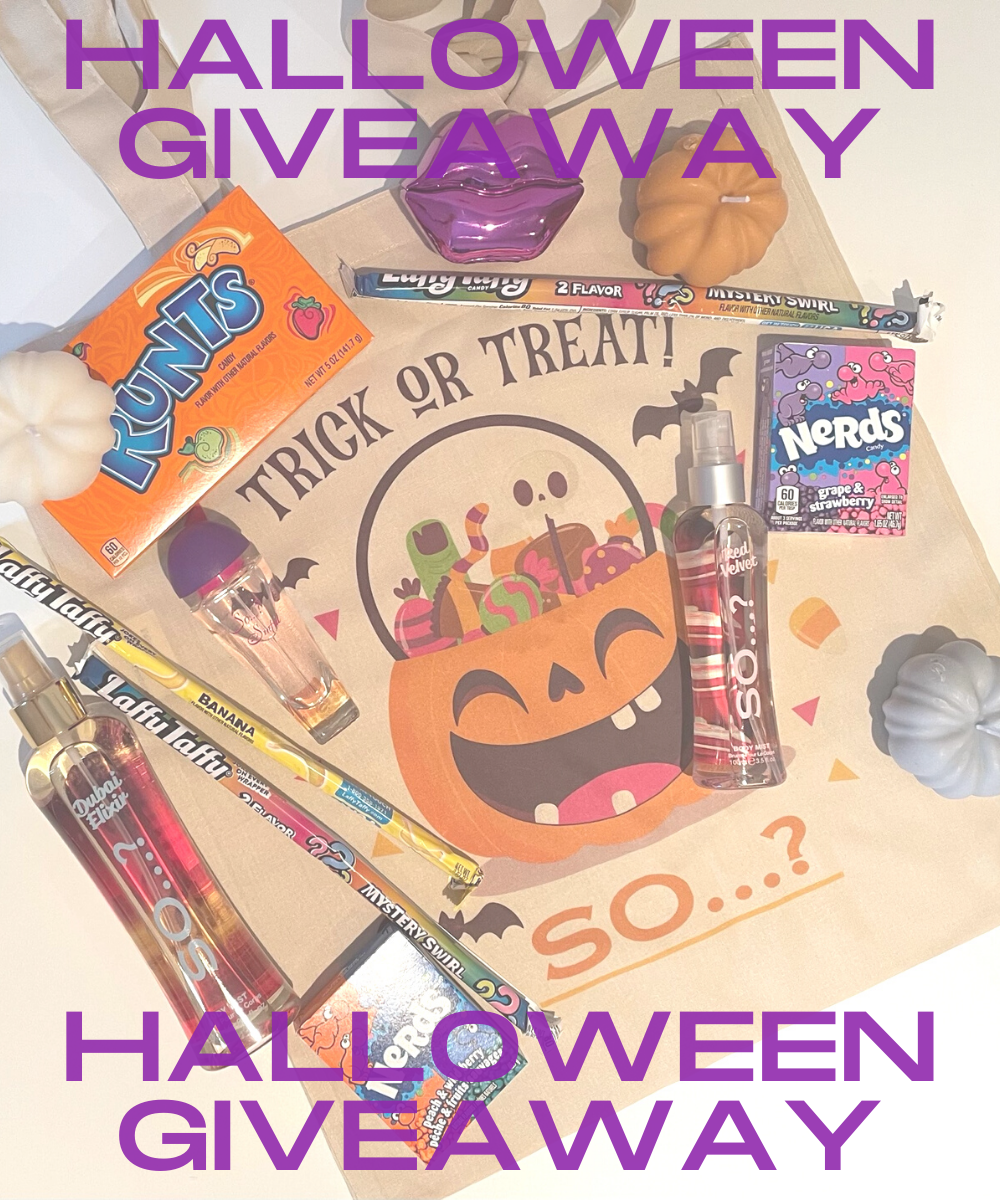
SO...? Fragrance Halloween Giveaway! Oct 19, 2021


Keep every bottle cool, dark, dry, upright and capped, and leave it boxed until you actually use it. Those five conditions do more to protect a fragrance than any premium bottle design ever could. The four things working against you are heat, light, air and humidity, and each one breaks down the scent in a different way. If your home runs hot year round, or you own a bottle you’re not using anytime soon, a dedicated mini fridge is worth considering. Otherwise, a drawer beats a windowsill every time.
TL;DR:
- Keeping perfume bottles in dark, stable environments like drawers or boxes minimizes light and temperature fluctuations that accelerate degradation.
- Proper handling habits, such as sealing caps tightly, storing bottles upright, and rotating display bottles, significantly extend fragrance longevity.
- Decanting for travel is acceptable for short trips but can speed up aging due to increased oxygen exposure, especially in poorly made plastic atomizers.
- Refrigeration may preserve rare or long-term bottles in hot climates but should be done with a sealed box and minimal movement to avoid moisture issues.
- Signs of perfume deterioration include darkening, cloudiness, sour odor, and loss of top notes, and degraded perfumes can often be repurposed rather than discarded.
Table of Contents
- What are the four enemies of perfume, and how do you beat them?
- Where should you actually keep your perfume at home?
- How should you handle bottles, caps and boxes day to day?
- Is decanting into a travel atomiser bad for your perfume?
- When does refrigeration actually make sense?
- How can you tell if a perfume has gone off?
- How Sofragrance builds storage-friendly habits into its products
- Why boring storage beats a pretty shelf display
- Travel sets and everyday mists that skip the decanting problem
- Sources
- FAQ
What are the four enemies of perfume, and how do you beat them?
Perfume is a chemical mixture, and chemical mixtures react to their environment whether you want them to or not. Heat speeds up the evaporation of alcohol and top notes, which is why a fragrance left in a warm car smells thinner within weeks. Light, particularly UV light, triggers photooxidation, a reaction that breaks down aromatic compounds and can shift both colour and scent. Air exposure introduces oxygen every time you leave a cap off or use an open decant, and oxidation is a one-way process. Humidity swings, meanwhile, stress the glass, metal and rubber components of the bottle itself, not just the liquid inside.
The fix for all four is the same principle applied consistently: reduce exposure, reduce fluctuation.
- Keep bottles away from windows, radiators and anywhere that gets direct sun for even part of the day.
- Recap immediately after every spray, and press it down fully rather than resting it on top.
- Store in a drawer, wardrobe or the original box rather than on open display.
- Avoid rooms where temperature and humidity change throughout the day.
Pro tip: If you can’t remember the last time you dusted a bottle on your shelf, it’s probably been absorbing more light and heat than you realise.
Opened perfume typically holds its character for three to five years when stored properly, though citrus-forward eaux de toilette fade faster than dense ambers and woody bases built on heavier, more stable molecules.
Where should you actually keep your perfume at home?
The best spot is almost always the least glamorous one. Rank your options like this:
- A closed drawer or wardrobe shelf. Dark, stable, and shielded from daily light and temperature cycles.
- A boxed bottle on a low, shaded shelf. Nearly as good as a drawer, and easier to access if you rotate scents often.
- A vanity or open shelf, but only if shaded and rotated regularly. Acceptable for a bottle you’re actively using, not for long-term storage.
The bathroom feels like the natural home for perfume, and it’s the worst choice you can make. Steam from showers pushes humidity up and down constantly, and that swing accelerates degradation faster than steady heat would. The Good Housekeeping Institute specifically warns against bathroom storage for this reason, recommending bedrooms and closets instead. Kitchens have the same humidity problem plus heat from cooking, cars bake in the sun, and a sunny windowsill is essentially a slow-motion oven. A vanity near a window is sneakier: it creates a daily temperature-light cycle that ages the fragrance even when the room itself never feels particularly warm.
A practical fix: pick one “daily” atomiser to keep out and rotate through, and box up everything else.
How should you handle bottles, caps and boxes day to day?
Small habits protect fragrance more than any storage location alone. Get these right and you’ve solved most of the problem before it starts.
- Always click the cap fully closed after use rather than balancing it on top.
- Store bottles upright, never on their side, to protect the gasket and stop leaks.
- Avoid shaking the bottle, which introduces air bubbles and speeds oxidation.
- Keep the original box wherever possible. It blocks light and buffers small temperature swings far better than the bottle alone.
- If you like a bottle on display, rotate it and keep true backups boxed and untouched.
Pro tip: Treat the box as part of the perfume, not packaging you throw away. It’s doing real preservation work.
Fragile, citrus-heavy scents benefit most from this discipline, since they degrade faster than heavier compositions, so if you’re going to be strict with anything, be strict with those first.
Is decanting into a travel atomiser bad for your perfume?
Not for a weekend, no. But decants and travel atomisers are a short-term convenience, not a storage method. Splitting perfume into a smaller container increases the ratio of air to liquid inside it, and that extra oxygen exposure means a decant ages faster than the sealed bottle it came from.
A few habits keep decants sensible rather than risky:
- Fill travel atomisers as close to full as possible to shrink the air pocket.
- Choose glass or well-made atomisers over cheap plastic, which can absorb or leach into the fragrance.
- Clean the nozzle occasionally to avoid buildup that can taint later refills.
- Leave the full-size bottle sealed, boxed and at home; use the travel version purely for portability.
Think of a decant as a temporary loan from the real bottle, not a replacement for it.
When does refrigeration actually make sense?
For most homes, it doesn’t. But there are two situations where a fridge earns its place: a consistently hot climate with no reliable air conditioning, or a rare, archival bottle you want to preserve for years rather than use regularly.
If you go this route, do it properly:
- Use a small, dedicated mini fridge rather than the one holding your food, to avoid odour transfer.
- Keep bottles in a sealed box inside the fridge to limit condensation on the glass.
- Avoid moving the bottle in and out of the fridge repeatedly. That temperature cycling causes condensation and moisture problems worse than steady room-temperature storage.
- Skip the freezer entirely. It’s an unnecessary extreme that risks cracking glass and separating the formula.
Refrigeration is an archival tool, not a daily habit, so save it for the bottle that genuinely needs it.
How can you tell if a perfume has gone off?
Trust your nose before you trust the calendar. A few reliable signs:
- The liquid has darkened noticeably compared to when you bought it.
- You spot sediment or cloudiness that wasn’t there originally.
- The scent smells sour, sharp or metallic instead of how you remember it.
- Top notes vanish almost immediately, leaving a flat or unpleasant base.
Spray a small amount on a tissue first, and only test on skin if it smells normal. If a bottle irritates your skin or smells off in any way, stop using it there. Degraded perfume that still has a pleasant enough smell can often get a second life as a fabric spray, drawer freshener, or scent for a wax warmer, rather than being thrown out entirely.
How Sofragrance builds storage-friendly habits into its products
A good routine is to keep special bottles boxed, and use something more disposable for daily wear. That’s the thinking behind pairing a travel giftset with a body mist you’re happy to spray without a second thought. Travel minis are built for exactly the kind of short-term, higher-exposure use that would otherwise wear down a full-size EDT, while a mist from the layering collection is designed to be used freely rather than rationed. A simple long-term routine could be: one travel set in a bag or suitcase, one main bottle boxed at home, and a body mist for daily use.
Why boring storage beats a pretty shelf display
Display shelves photograph well and preserve almost nothing. Every hour a bottle spends catching light on an open shelf is an hour it’s quietly ageing faster than it needs to, and most people only realise this once a favourite scent already smells different.
The fix isn’t to hide your whole collection. It’s to be honest about which bottles you’re actually using this month, keep those out, and box everything else without guilt. Prioritise the scents you’d genuinely be upset to lose, not the ones that look nicest on a dresser.
— Damini
Travel sets and everyday mists that skip the decanting problem
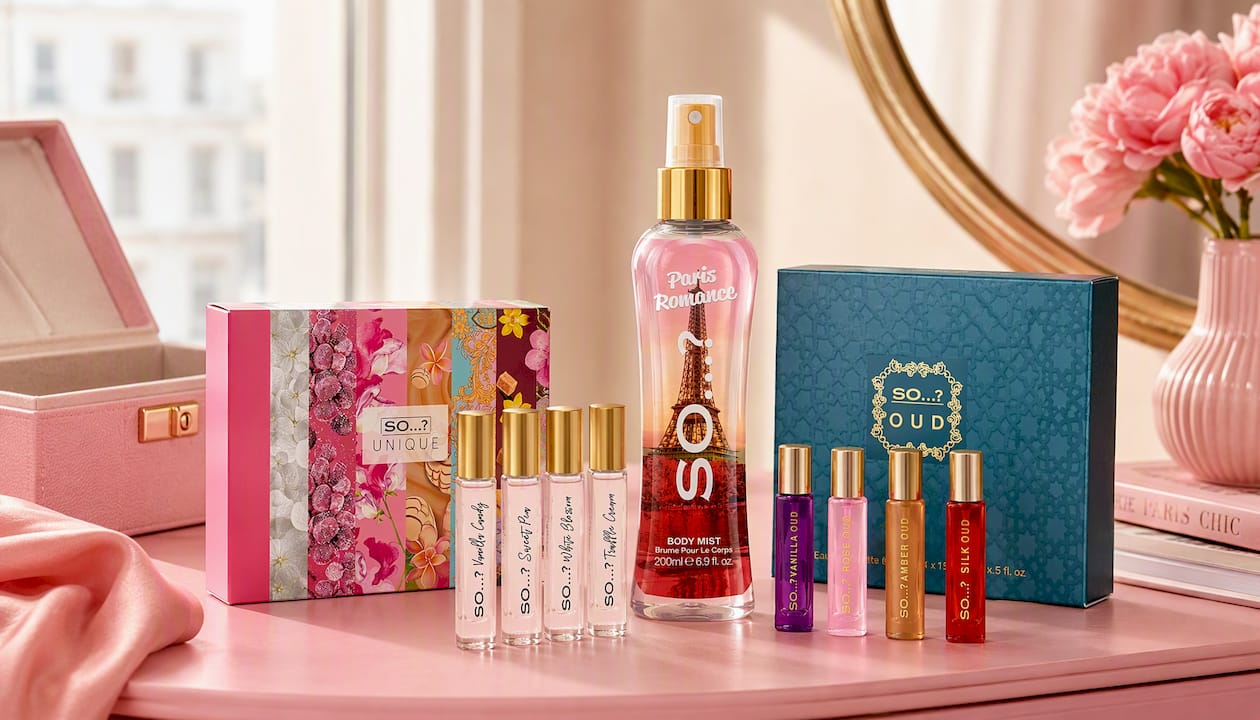
An effective approach to travel is to avoid decanting a full bottle just to take a few scents on a trip. The SO…? Unique Travel Size Mini Premium EDT Giftset (4 x 14ml) gives you four sealed minis instead, so there’s no air pocket forming in a half-filled atomiser and no risk of a leak in your washbag. For something bolder, the SO…? Oud Travel Size Mini Premium EDT Giftset (4 x 15ml) works the same way, giving you variety without opening up your main bottle to unnecessary handling.
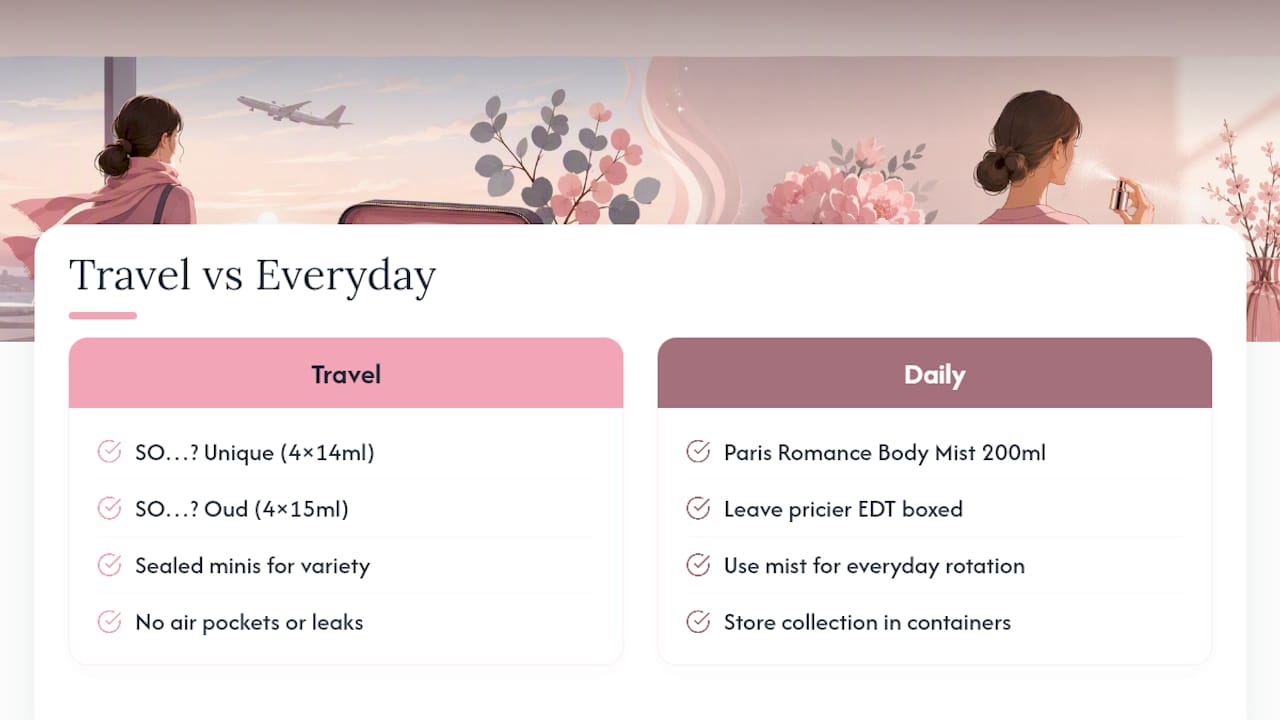
For daily wear at home, the Paris Romance Body Mist 200ml is the bottle you reach for without thinking twice, leaving your pricier eau de toilette boxed and untouched until you actually want it. If your bottles tend to bake in a hot bedroom over the summer months, pairing that with proper storage containers for the rest of your collection keeps everything shielded from light and heat swings. Start with the travel giftset for your next trip, and let the body mist handle the everyday rotation.
Sources
- Beauty experts say you should never store perfume here — Good Housekeeping
- The trick to make my perfume last so much longer — RealSimple
- Where to store your perfume at home — The Perfume Stash
FAQ
What is the 50/30/20 rule in perfume?
This isn’t a recognised fragrance storage or application standard. If you’ve seen it referenced, it’s likely being confused with budgeting terminology rather than genuine perfume guidance.
What is the Vaseline trick for perfume?
Some people dab a thin layer of petroleum jelly on pulse points before spraying, claiming it helps the scent last longer on skin. There’s no reliable evidence this affects bottle storage or shelf life, so it has no bearing on how you should keep your perfume long term.
What are some good ideas for storing perfume?
Keep bottles upright, capped, boxed and out of direct light in a drawer or wardrobe rather than on a bathroom shelf or windowsill. A dedicated giftset like the SO…? Unique Travel Size Mini Premium EDT Giftset also avoids the need to decant a full bottle for trips.
What is the 5 spray rule?
There’s no established fragrance industry standard by this name. If you’ve encountered it, it’s most likely informal advice about spray count for longevity, not a verified storage guideline.
How long does perfume actually last once opened?
Most fragrances hold up well for three to five years when stored cool, dark and capped, though citrus-heavy scents fade faster than dense ambers and woods.
