

-

Signature Scent vs Layering: Choose Fast, Start With Two Bottles Oct 10, 2026
-

Science Backed Tips to Make Fragrance Last Longer Without Heavy Sprays Oct 09, 2026
-

24–72 Hour Test for Light Fragrances for Sensitive Noses Oct 08, 2026
-

What You Actually Smell: Test Perfume Notes in 15 Minutes–4 Hours Oct 07, 2026
-

Make Perfume Last in Hot Weather: 2–3 Light Sprays Oct 06, 2026
-

Three Bottle Scent Wardrobe: Build a Wearable Collection for Layering Oct 05, 2026
-

Patch Test 48–72hr: Hypoallergenic Body Mists for UK Sensitive Skin Oct 04, 2026
-

Affordable UK Winter Body Mists: 3 Mist Bundles for Cozy Layering Oct 03, 2026
-

Five Sprays, No Rubbing: Where to Apply Perfume for Longest Wear Oct 02, 2026
-

3–5 Years or Longer: UK Perfume Shelf Life, PAO and Storage Tips Oct 01, 2026


Perfume dry down is the final stage of a fragrance’s evolution on skin, when the volatile top and heart notes have evaporated and the base materials, such as woods, musks and resins, become the dominant scent. It typically begins 30 to 60 minutes after application and keeps developing for hours afterwards. This is the smell that stays with you all day, which makes it far more important to your buying decision than whatever hits your nose in the shop.
TL;DR:
- The dry down phase typically begins after about an hour and can last four hours or more, with base notes gradually becoming more prominent.
- Variations in skin type, application method, and environmental conditions can significantly affect the timing and character of a fragrance’s dry down.
- Testing a perfume over several hours on both skin and fabric provides a more accurate understanding of its long-term scent development.
- Base notes such as musk, resin, and wood materials influence the dry down’s longevity and character, independent of gendered marketing labels.
- Layering fragrances with matching or complementary products can extend and deepen the dry down, tailoring the scent to personal preferences.
Table of Contents
- What are the three stages of a fragrance’s life?
- Why does perfume dry down happen at all?
- How long does dry down take and what changes it?
- How do you test a perfume’s dry down at home?
- Dry down, base notes and longevity: what’s the difference?
- Does layering change how a fragrance dries down?
- Which fragrance families dry down differently?
- How do specific ingredients shape the dry down?
- Do men’s and women’s perfumes dry down differently?
- How can you enhance or change your dry down?
- Trust the dry down when choosing your signature scent
- Build a dry down worth keeping
- Sources
- FAQ
What are the three stages of a fragrance’s life?
Every perfume moves through three acts, and understanding them stops you judging a bottle by its first five minutes. The top notes are the opening act: citrus, light fruits, or aldehydes that grab attention but fade fast. Next come the heart notes, often florals or spices, which bridge the gap and give the fragrance its personality for the middle stretch of wear. Finally, the dry down arrives as the base notes, woods, amber, musk, resins, settle in and become the scent you actually wear for the rest of the day.
- Top notes: citrus, herbs, light fruits, roughly 15 to 30 minutes
- Heart notes: florals, spices, gourmand accords, roughly the next 1 to 2 hours
- Dry down: woods, musks, ambers, resins, from around an hour onwards and lasting for hours
Perfumers build this sequence on purpose. A fragrance that opens with a bright citrus burst but settles into a warm sandalwood or vanilla base is engineered that way, not accidental. The evaporation curve that governs this shift is chemistry, not marketing.
Why does perfume dry down happen at all?
Different aromatic molecules evaporate at different speeds, and that mismatch is the entire mechanism behind dry down. Light molecules like citrus terpenes and aldehydes are highly volatile. They lift off the skin quickly. Heavier molecules such as [woods, musks, ambers and resins] evaporate far more slowly](https://pmc.ncbi.nlm.nih.gov/articles/PMC12666731/), which is exactly why they’re still there hours later while the top notes have long gone.
Your skin plays a role too. Oil levels, temperature and even pH affect how a fragrance’s materials sit on you. Oilier skin tends to hold onto molecules longer and can amplify warmth in a base note, while drier skin lets a fragrance move through its stages faster and sometimes more faintly. Higher body temperature speeds up evaporation across the board, which is part of why the same perfume smells different on two people, or on the same person in summer versus winter.
This differential evaporation is what produces the three-act curve. Nothing about the top notes changes chemically, they simply leave the stage while the slower base materials, present in the formula from the first spray, become audible once the noise around them dies down.
How long does dry down take and what changes it?
Timing follows a rough pattern, though no two fragrances behave identically. The opening runs from 0 to 30 minutes, the heart stage develops over the next 1 to 2 hours, and the dry down typically establishes itself from around 1 hour onwards, continuing to shift for 4 hours or more. Industry guidance is consistent on one point: wait at least 4 hours before forming a final opinion.
Several factors speed up or slow down that timeline:
- Concentration: an EDP holds a higher oil concentration than an EDT, so it generally moves through its stages more slowly and lasts longer.
- Skin type: oily skin extends wear and deepens base notes; dry skin shortens it.
- Application site and amount: pulse points (wrist, neck) run warmer and accelerate evaporation compared with cooler areas like the forearm.
- Skin versus fabric: fragrance sprayed on clothing evaporates more slowly and can smell noticeably different at the dry down stage than the same spray on skin.
- Humidity and temperature: heat and dry air speed evaporation; cool, humid conditions slow it.
Pro Tip: If you’re testing a new fragrance in a heated shop in December, don’t trust what you smell. Warm indoor air accelerates the top notes and can flatten the dry down entirely, giving you a false read on how the perfume behaves at home.
How do you test a perfume’s dry down at home?
You don’t need special equipment, just patience and a system. A single spray, tracked over several hours, tells you more than ten sprays smelled once.
- Apply one spray to a pulse point, such as the inner wrist, and note the time.
- Check at 20 to 30 minutes to catch the top notes before they vanish.
- Check again at 1 to 2 hours as the heart notes take over.
- Do a final check at 4 hours, the point most testing guides treat as the true test of a fragrance’s character.
- Spray a second test on fabric, a scarf or cotton swatch, and compare it against the skin version, since fabric holds onto notes differently and can mislead you about how the dry down actually smells on you.
Keep brief notes each time you check: what you smell, how strong it is, whether it’s pleasant. Watch for warning signs, a harsh, plasticky shift as synthetic musks take over unpleasantly, or a dry down that turns cloyingly sweet once the citrus lifts. Both are common reasons people fall out of love with a bottle by hour three.
Dry down, base notes and longevity: what’s the difference?
These three terms get used interchangeably, and that’s where a lot of buying confusion starts. Base notes are the specific ingredients, sandalwood, amber, vanilla, musk, listed in a formula. Dry down is the evolving scent experience once those base notes take over, shaped by how they interact with everything else in the composition and with your skin. Longevity is simply how long you can detect the fragrance at all.
A fragrance can have a genuinely lovely dry down without lasting sixteen hours, and a fragrance can last all day while smelling thin or unremarkable in its final stage. Materials associated with pleasing dry downs, soft musks, balsams, ambers, aren’t always the same ones used purely to extend wear time; some ingredients exist mainly for staying power rather than character. Don’t assume “long-lasting” on a label means “settles beautifully.”
Does layering change how a fragrance dries down?
Yes, and it’s one of the more underused tricks in a fragrance lover’s routine. Moisturised or oil-primed skin slows evaporation, which means base notes can deepen and extend rather than fading on schedule. A matching body mist applied before or after a perfume works the same way, adding a second, complementary layer of the same scent family that reinforces the dry down rather than competing with it.
Practical ways to experiment:
- Apply an unscented or lightly scented body lotion before spraying to slow the whole evaporation curve.
- Layer a matching body mist with an EDT or EDP in the same scent family to build a fuller, longer-lasting base.
- Try a travel-size or bundle format before committing to a full bottle, since it lets you test how two scents settle together without much financial risk.
Small changes to how you apply a fragrance can shift its dry down more than switching to an entirely different bottle.
Which fragrance families dry down differently?
Fragrance families don’t just smell different at the top, they behave differently as they settle, and knowing the pattern helps you predict what you’re buying before the bottle’s even opened.
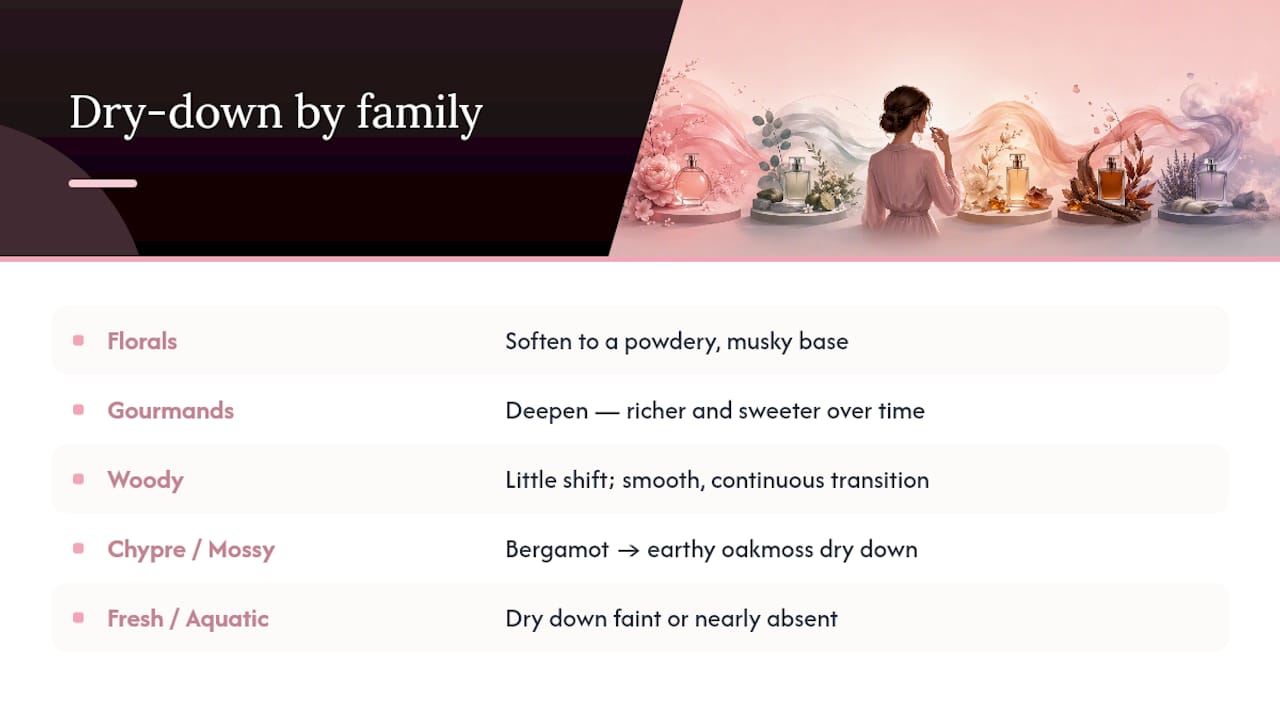
Florals tend to soften into a powdery, musky base once the bright petal notes fade, think a rose or jasmine composition settling into something warmer and less sharp. Gourmands, built on vanilla, caramel or cocoa, usually deepen rather than change character, growing richer and sweeter as the top notes lift. Woody fragrances often barely shift at all, since materials like cedar or sandalwood sit in both the heart and base, giving a smoother, more continuous transition. Chypre and mossy compositions shift from a sharp bergamot opening to an earthy, oakmoss-driven dry down that can feel almost unrecognisable from the first spray. Fresh and aquatic scents are the trickiest: many rely almost entirely on volatile top and heart materials, so their dry down can be faint or nearly absent, which is worth knowing if you want a scent that lasts.
Fruity and sweet fragrances, the category a lot of body mists and layering scents fall into, typically settle into a soft musk or light amber base that keeps the fruit’s warmth without the initial sharpness. This is part of why fruity gourmand blends work so well for layering: their dry downs are gentle enough to combine with a second scent without clashing.
Knowing your preferred family’s typical dry down pattern saves you from buying on first impression alone, then feeling let down three hours later.
How do specific ingredients shape the dry down?
Not all base materials behave the same way, and the ingredient list tells you a lot about what to expect hours after application.
Musks are the workhorses of most dry downs. Modern synthetic musks are typically soft, clean and slightly skin-like, which is why so many fragrances converge on a similar warm, comforting base regardless of how different their openings were. Resins, frankincense, myrrh, benzoin, bring a warmer, slightly smoky or balsamic quality, and they’re partly why some dry downs feel almost edible or incense-like. Woods such as sandalwood, cedar and vetiver add structure and dryness. They’re often described as giving a fragrance “backbone,” stopping a sweet or floral composition from feeling flat once the top notes disappear.
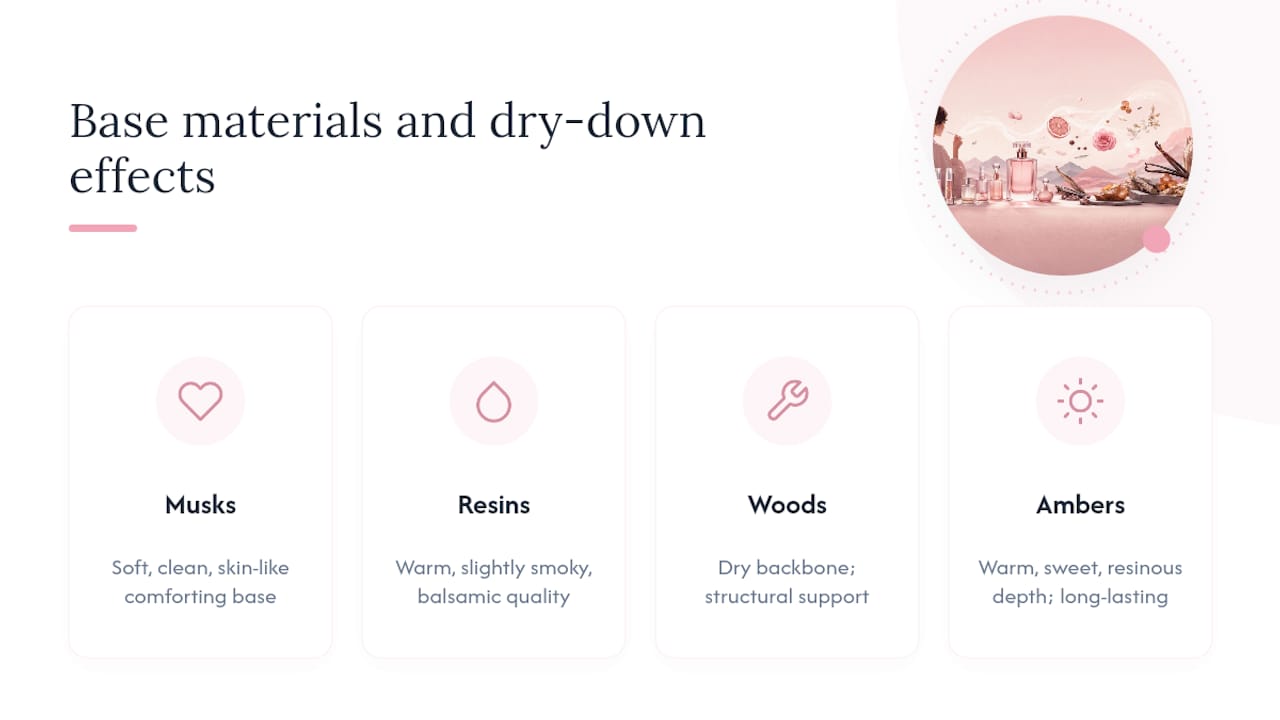
Ambers (technically amber accords, since natural ambergris is rare and heavily regulated) contribute warmth and a slightly sweet, resinous depth that lingers exceptionally well, which is why so many long-lasting fragrances lean on them. Vanilla and tonka bean sit somewhere between gourmand and base material, adding sweetness that tends to soften harsher woods or resins in the final stage.
Because these materials are all low-volatility, they evaporate slowly and linger together, blending into a composite dry down rather than presenting as distinct notes the way top notes often do. If you love a particular dry down and want to find something similar, checking the ingredient list for musk, resin and wood combinations is a far more reliable method than trusting a brand’s marketing copy.
Do men’s and women’s perfumes dry down differently?
The honest answer is that gendered marketing has less to do with actual dry down chemistry than most people assume. Fragrances labelled “masculine” more often lean on woods, leather, spices and stronger musks, giving dry downs that read as drier, sharper or more resinous. Fragrances marketed as “feminine” more often lean on florals, fruits, gourmand sweetness and softer musks, giving dry downs that trend rounder and warmer.
But these are marketing conventions built on historical formulation habits, not fixed rules about how base materials behave. A vetiver or sandalwood dry down works exactly the same way whether it’s in a bottle marketed to men or women, because the chemistry, volatility and evaporation rate, doesn’t check the label. The rise of shared, unisex-marketed fragrances over the past couple of decades has made this obvious: plenty of “women’s” perfumes now carry traditionally “masculine” woody or leathery dry downs, and vice versa.
What genuinely does vary by product category is concentration and format. Fragrances marketed toward women often appear across more formats, EDT, EDP, body mist, layering oil, giving more opportunities to build and customise a dry down through layering. This is one reason body mists have become such a popular tool for younger fragrance wearers: they let you build a personal dry down out of multiple lighter products rather than relying on a single, fixed formula. Skin chemistry, not gender, remains the biggest single variable in how any given dry down actually presents.
How can you enhance or change your dry down?
A handful of habits change your dry down more than switching perfumes entirely.
Moisturise strategically. An unscented lotion applied before spraying slows evaporation across the board, which typically deepens and extends the base stage. Layer scents in the same family. A body mist and a perfume that share notes reinforce each other’s dry down instead of fighting for attention. Apply to pulse points and hair. Warmer areas accelerate the early stages but hair holds fragrance differently and can carry a softer version of the dry down for longer. Avoid rubbing your wrists together. This breaks down the top note molecules and can distort how the fragrance develops through its stages.
Don’t over-spray. Piling on more product doesn’t necessarily deepen the dry down, it can just extend the top and heart stages and delay the base from coming through cleanly. Test at consistent sites without re-spraying, since evaluating at the same spot each time and resisting the urge to top up gives you the truest read on how a formula actually settles.
If you consistently dislike how a favourite fragrance dries down, the fix is rarely a different perfume. It’s usually a different application routine, less product, better skin prep, or a complementary layer, rather than an entirely new bottle.
Trust the dry down when choosing your signature scent
Give any fragrance real time before you judge it. Wear it for several hours, because your skin chemistry will always make the dry down personal to you, no review can predict that part. If the base doesn’t excite you at first, try layering rather than writing the bottle off. Sometimes the right pairing is the only thing missing.
— Damini
Build a dry down worth keeping
Some fragrance brands are built around exactly the kind of experimentation this article recommends: instead of committing to one fixed formula and hoping the dry down suits you, you combine lighter, affordable layers until it does. That’s a genuinely different approach from buying a single designer bottle and hoping for the best, because you’re building your dry down rather than gambling on it.
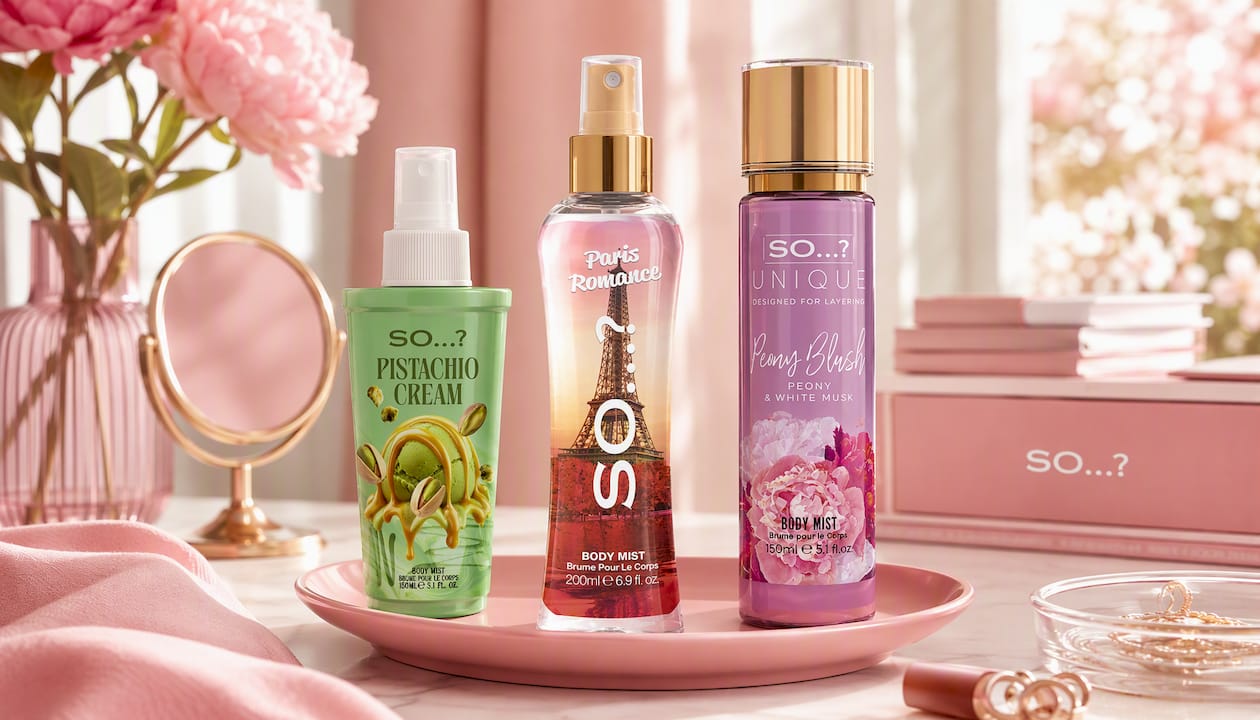
Start with something food-inspired and warm, Pistachio Cream from the So Delish range, and layer it under a lighter top note for a base that develops into something genuinely your own. If florals are more your style, the Paris Romance body mist or the Peony Blush mist both give you a soft, musky settle that pairs easily with a matching EDT. Pick one, spray it on skin, wait four hours, and see what’s still there. That’s the real test.
Sources
- The evaporation curve: a formula’s three acts
- What is drydown in perfume? | Scented Chemistry
- How long to test a perfume (practical testing guide)
FAQ
What is drydown in perfume?
Drydown is the final stage of a fragrance’s development on skin, once the volatile top and heart notes have evaporated and the slower base materials become dominant. It’s essentially the scent’s settled, long-term character rather than its first impression.
How long does it take for perfume to dry down?
Most fragrances begin entering their dry down within 30 to 60 minutes of application, though the full base character often takes an hour or more to establish and continues shifting for several hours after that. Testing guidance consistently recommends waiting at least 4 hours before judging the final result.
What are the three stages of fragrance?
Fragrances typically move through top notes, heart notes and dry down, which is a simpler and more accurate framework than the “five stages” language you sometimes see in marketing. Top notes are the light opening burst, heart notes form the middle character, and the dry down is the lingering base built from woods, musks, ambers and resins.
Does perfume dry down on clothes?
Yes, but it behaves differently than it does on skin, since fabric holds onto molecules at a different rate and lacks the warmth and oils that shape a skin dry down. It’s worth testing scent on both skin and fabric separately if you plan to wear a fragrance on clothing regularly, as the two can smell noticeably different by the four hour mark.
Can layering body mists change how a perfume dries down?
Yes. Adding a matching-scent body mist, or moisturising before applying perfume, slows evaporation and can deepen and extend the base notes rather than leaving them to fade on their own. Some layering-friendly body mists and bundles are designed specifically for this kind of experimentation.
